
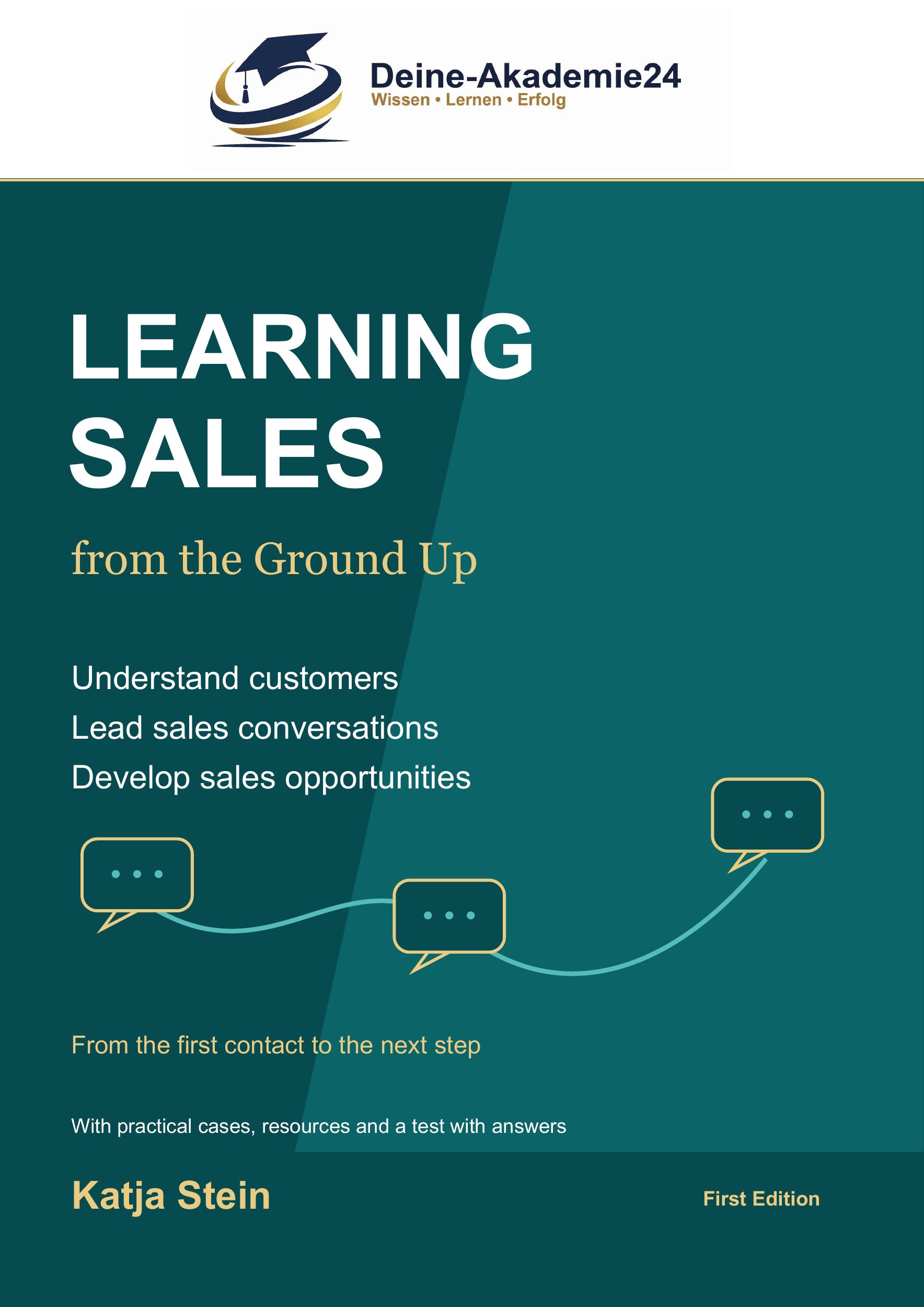
Beschreibung
What this book helps you do
Build a structured sales conversation: identify needs, explain value and agree next steps without pressure.
- Identify customer needs through purposeful questions and active listening.
- Translate product features into understandable customer benefits.
- Structure the opening, needs assessment, proposal and close.
- Explore objections about price, timing and decision readiness.
- Organise follow-up, CRM, pipelines and performance indicators.
- Apply practical cases, dialogue examples, checklists and self-assessment questions to your own work.
Who is this book for?
For newcomers, career changers and customer-facing staff who want to develop sales conversations, acquisition and sales organisation step by step.
Topics you will work through
- Sales fundamentals, roles and customer-oriented behaviour
- Needs assessment, questions and communication
- Product presentation and explaining value
- Preparation, objections and closing
- Acquisition, retention, CRM and indicators
- Cases, final test, templates and sample conversations
Look inside before you buy
48 pages: front matter, the complete table of contents and selected teaching or practice pages from this edition. No purchase or registration required. The extract retains the original page numbering.
Check the edition and review-status information below before buying. The sample shows the book as offered; it is not a guarantee of examination success or completed professional review.
View table of contents
Taken from the offered edition. The chapter numbering is retained. The original formatted contents pages are also included in the free PDF sample.
- Foreword
- How to use this book
- Part I The Fundamentals of Sales
- Chapter 1 Understanding the sales function
- 1.1 What sales is and what tasks it fulfills
- 1.2 The sales function selling marketing and customer service
- 1.3 Why companies need sales
- 1.4 Selling products and services
- 1.5 B2B and B2C business customers and private customers
- 1.6 Inside sales, field sales and telephone sales
- 1.7 From first customer contact to closing the sale
- 1.8 Typical misunderstandings about sales
- Chapter 2 Sales roles and responsibilities
- 2.1 What sales positions exist
- 2.2 Comparison of Inside Sales and Outside Sales
- 2.3 Tasks in telephone sales and new customer acquisition
- 2.4 Existing customer support and new customer acquisition
- 2.5 Sales Assistance and Sales Support
- 2.6 Typical daily routines and work processes
- 2.7 Sales targets, key performance indicators and performance measurement
- 2.8 Which skills are important for which position
- Chapter 3 The foundations of effective selling
- 3.1 What makes a good salesperson
- 3.2 Expertise, communication skills and reliability
- 3.3 Self-confidence without arrogance
- 3.4 Motivation and dealing with rejection
- 3.5 Customer focus instead of sales pressure
- 3.6 Building trust and credibility
- 3.7 Ethical principles in sales
- 3.8 Common beginner mistakes and how to avoid them
- Part II Understanding and Convincing Customers
- Chapter 4 Understanding customers and identifying needs
- 4.1 Why customers buy products
- 4.2 Differentiating between needs, desires and actual requirements
- 4.3 Objective and emotional buying motives
- 4.4 Target groups and differing customer expectations
- 4.5 Active Listening
- 4.6 Listen between the lines without jumping to conclusions
- 4.7 Determine the actual need
- 4.8 Document and summarize customer needs
- 4.9 Identifying and qualifying leads
- 4.10 Assessing purchase readiness and deriving next steps
- Chapter 5 Professional communication and questioning techniques
- 5.1 Fundamentals of successful communication
- 5.2 Open and closed questions
- 5.3 W-questions and targeted follow-up questions
- 5.4 Alternative and comprehension questions
- 5.5 Speaking time and active listening
- 5.6 Voice, speaking pace and word choice
- 5.7 Body language and nonverbal communication
- 5.8 Avoiding misunderstandings
- 5.9 Handling difficult conversation partners professionally
- Chapter 6 Presenting products and services clearly
- 6.1 Differentiating product features and customer benefits
- 6.2 Develop a comprehensible benefit argument
- 6.3 Explain the advantages clearly and convincingly
- 6.4 Adapting arguments to customer needs
- 6.5 Working with examples, comparisons and concrete situations
- 6.6 Present prices and services transparently
- 6.7 Argue credibly instead of exaggerating
- 6.8 Dealing with competing products and comparison questions
- 6.9 Communicating presentations and offers in an understandable way
- Part III The Sales Conversation in Practice
- Chapter 7 Preparing for sales conversations
- 7.1 Define the conversation goal
- 7.2 Gathering information about customers and companies
- 7.3 Using conversation guides effectively
- 7.4 Prepare appointments and meeting documents
- 7.5 Planning and formulating conversation starters
- 7.6 Anticipating potential customer questions
- 7.7 Define conversation objectives and realistic next steps
- 7.8 Checklist for preparing for the conversation
- 7.9 Digital appointment scheduling and online appointment booking
- 7.10 Creating and customizing conversation guides
- Chapter 8 Leading a sales conversation step by step
- 8.1 Greeting and professional start to the conversation
- 8.2 Create a pleasant atmosphere for conversation
- 8.3 Clarify the objective and procedure of the conversation
- 8.4 Determine needs and ask targeted questions
- 8.5 Presenting suitable solutions
- 8.6 Check understanding and interest
- 8.7 Answering follow-up questions
- 8.8 Shaping the transition to the conclusion
- 8.9 Summarizing the results of the discussion
- 8.10 Common mistakes in the conversation flow
- 8.11 Structured conversation models in sales
- 8.12 Applying conversation guidelines in practice
- Chapter 9 Handling objections and difficult situations
- 9.1 What distinguishes objections from pretexts
- 9.2 Why customers express concerns
- 9.3 That's too expensive for me
- 9.4 I need to think about it
- 9.5 I already have a provider
- 9.6 I have no interest
- 9.7 Dealing with uncertainty and rejection
- 9.8 Ask questions without applying pressure
- 9.9 When a sales attempt should be ended
- 9.10 Recognizing unfair or impermissible sales methods
- 9.11 Other typical customer objections and appropriate responses
- 9.12 Examples of conversations: unfavorable and professional answers
- Chapter 10 Closing a sale
- 10.1 What constitutes a sales deal
- 10.2 Recognizing and correctly interpreting buy signals
- 10.3 Concluding Questions and Decision-Making Aids
- 10.4 Clarify open questions before making a decision
- 10.5 Confirm prices, conditions and services
- 10.6 Agree on the next steps in a binding manner
- 10.7 Dealing with a "no" professionally
- 10.8 Avoid final pressure and manipulation
- 10.9 Documenting the conclusion
- Part IV Acquisition, Customer Retention and Sales Organization
- Chapter 11 Prospecting follow up and customer retention
- 11.1 What acquisition means and what goals it pursues
- 11.2 Differentiating between cold calling and warm calling
- 11.3 Making initial contacts professional
- 11.4 Contact by telephone and in writing
- 11.5 Follow up at the right time
- 11.6 Follow-up reminders and systematic contact management
- 11.7 Maintaining and retaining existing customers in the long term
- 11.8 Handling complaints professionally and finding solutions
- 11.9 Developing recommendations and follow-up business
- 11.10 Legal limits on advertising and contact
- 11.11 Prioritize leads and assess contact opportunities
- 11.12 Reactivate and win back existing customers
- 11.13 Use cross-selling and upselling in a customer-oriented manner
- 11.14 Winning recommendations and customer reviews
- 11.15 Establish a systematic follow-up process
- Chapter 12 Organising sales work and improving results
- 12.1 Daily and weekly planning
- 12.2 Setting priorities and using time effectively
- 12.3 CRM systems and customer documentation
- 12.4 Understanding sales metrics
- 12.5 Calculate contact rate, appointment rate and closing rate
- 12.6 Evaluating your own results
- 12.7 Learning from mistakes and reflecting on conversations
- 12.8 Developing personal learning goals
- 12.9 Digital tools in everyday sales
- 12.10 Data protection and confidential handling of customer data
- 12.11 Building and managing a sales pipeline
- 12.12 Systematically track sales activities
- 12.13 Analyze and improve sales processes
- Part V Application and Knowledge Review
- Chapter 13 Practical cases from everyday sales work
- 13.1 An initial consultation with a new client
- 13.2 A needs assessment in the service sector
- 13.3 A customer considers the price too high
- 13.4 A prospective buyer is not yet ready to decide
- 13.5 A customer compares several providers
- 13.6 A dissatisfied existing customer
- 13.7 A prospective buyer does not respond to the first offer
- 13.8 An existing customer requires an additional service
- 13.9 A sales pipeline with multiple open sales opportunities
- 13.10 A complete sales conversation from start to finish
- Chapter 14 Final test of sales knowledge
- 14.1 Fundamentals of Sales
- 14.2 Job profiles and organization
- 14.3 Customer needs and communication
- 14.4 Presentations and customer benefits
- 14.5 Preparing and conducting the conversation
- 14.6 Objections and closing a sale
- 14.7 Prospecting customer care and follow up
- 14.8 CRM Key Performance Indicators and Sales Organization
- 14.9 Scoring answers and learning recommendations
- Part VI Practical Appendix and Practical resources
- Appendix A Checklists and Templates
- A.1 Checklist for preparing for the conversation
- A.2 Template for needs assessment
- A.3 Sample conversation guide
- A.4 Checklist for product presentation
- A.5 Template for objection analysis
- A.6 Checklist for closing the sale
- A.7 Template for follow-up and follow-up reminders
- A.8 Templates for CRM documentation
- A.9 Template for evaluating a sales pipeline
- Appendix B: Sample conversations and phrasing aids
- B.1 Professional Conversation Starters
- B.2 Examples of open, closed and in-depth questions
- B.3 Explaining customer benefits based on various products and services
- B.4 Typical customer objections and possible answers
- B.5 Phrases for follow-up conversations
- B.6 Examples of customer-oriented closing questions
- B.7 Phrases for complaints and difficult conversations
- Glossary of terms: Important sales terms and abbreviations
- Sources and further information
- Advertising message
- Proof of telephone advertising
- Data protection
- Data breaches
- SPIN
- Net Promoter Score
- Your next step
Further edition and purchase information
Learning Sales from the Ground Up
First Edition · Author Katja Stein
A practical sales handbook in English: understand customers, lead sales conversations and develop opportunities. Includes sample conversations, practical resources and 32 questions with explained answers.
You receive the complete book as a PDF with front and back covers. Language: English. Length: 846 PDF pages.
For newcomers, career changers and anyone who wants to develop a systematic approach to sales. The legal sections retain their German and EU context.