
Beschreibung
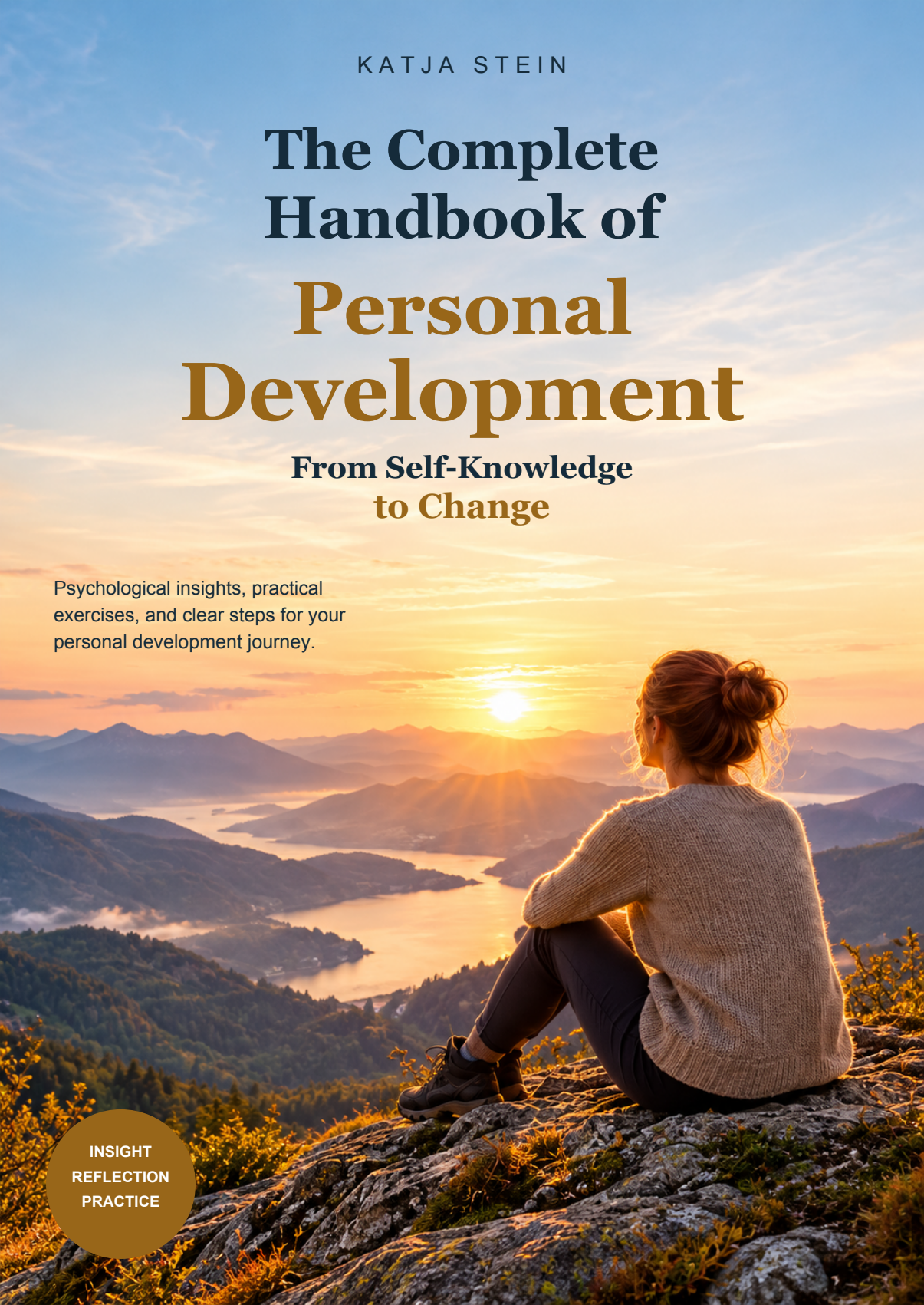
From Self-Knowledge to Change
Katja Stein guides you through four parts: Know Yourself, Understand Yourself, Change Yourself, and Unlock Your Potential.
The handbook combines psychological explanations with fictional case studies, reflection questions, and practical exercises. Lena’s fictional career restart connects the four parts.
- 56 chapters and 355 numbered subsections
- 21 reproducible worksheets
- 15 color diagrams
- A 90-day program for reflection and practice
- References, glossary, and index
Topics include self-image, values, beliefs, emotions, habits, communication, relationships, self-leadership, resilience, and life balance. Scientific findings, coaching models, and philosophical perspectives are distinguished.
Your download
Complete English PDF edition including front and back cover, 779 pages. Digital book; no printed copy. The exercises support self-reflection and do not replace individualized medical or psychotherapeutic care.
Expand the complete table of contents
Part I – Know Yourself
Section 1 – Self-Knowledge, Identity, and Personality
Chapter 1 – Who Am I Really?
- 1.1 The question of one's own self
- 1.2 Personality, character, temperament and identity
- 1.3 Self-image and others’ perceptions
- 1.4 Conscious and less conscious behavior patterns
- 1.5 Blind spots and self-deception
- 1.6 Why self-knowledge is the starting point for change
Chapter 2 – How Our Personality Develops
- 2.1 Genetic influences and temperament
- 2.2 Childhood, upbringing and caregivers
- 2.3 Attachment experiences and their possible consequences
- 2.4 School, society and cultural influence
- 2.5 Formative life events and experiences
- 2.6 Personality across the lifespan
- 2.7 What can be changed about our personality
Chapter 3 – My Roles and My Identity
- 3.1 Private, professional and social roles
- 3.2 Expectations of other people
- 3.3 Role conflicts and internal contradictions
- 3.4 Authenticity and adaptability
- 3.5 Who am I without my achievements and titles?
- 3.6 Consciously develop your own identity
Chapter 4 – Strengths, Weaknesses, and Personal Potential
- 4.1 Distinguish talents, skills and competencies
- 4.2 Recognize your own strengths
- 4.3 Identify personal development areas
- 4.4 Use feedback constructively
- 4.5 Self-efficacy and personal resources
- 4.6 Your own potential analysis
Chapter 5 – Self-Reflection as a Key to Development
- 5.1 Why we don't always assess ourselves objectively
- 5.2 Use reflection questions correctly
- 5.3 Journaling and personal assessment
- 5.4 Your own lifeline
- 5.5 Recognize recurring behavior patterns
- 5.6 Self-reflection without excessive rumination
Section 2 – Personality Types and Understanding People
Chapter 6 – The Four Color Styles of Personality
- 6.1 Origin and basic idea of the DISC model
- 6.2 The four behavioral styles in detail
- 6.3 Strengths and possible downsides
- 6.4 Mixed types and situation-dependent behavior
- 6.5 Behavior under stress
- 6.6 Communication with different styles
- 6.7 Limitations of color models and typifications
Chapter 7 – The Big Five: The Scientific Model of Personality
- 7.1 The five basic personality dimensions
- 7.2 Openness to experiences
- 7.3 Conscientiousness
- 7.4 Extraversion
- 7.5 Agreeableness
- 7.6 Negative emotionality or neuroticism
- 7.7 Personality traits as a continuum
- 7.8 What personality tests actually say
Chapter 8 – Other Well-Known Personality Models
- 8.1 MBTI and the 16 types
- 8.2 Enneagram and its nine patterns
- 8.3 Temperament models
- 8.4 Transactional analysis and ego states
- 8.5 Scientific significance and limitations
- 8.6 Which model is suitable for which purpose?
Chapter 9 – My Personal Personality Profile
- 9.1 Recognize your own behavioral tendencies
- 9.2 Derive strengths and challenges
- 9.3 Personality and communication
- 9.4 Personality in relationships and work
- 9.5 Compare self-image and others’ perceptions
- 9.6 Create personal development profile
Section 3 – Values, Needs, and Inner Drivers
Chapter 10 – My Personal Values
- 10.1 What values are and how they arise
- 10.2 Personal, social and professional values
- 10.3 Freedom, security, success, family and recognition
- 10.4 Value hierarchies and conflicting goals
- 10.5 Why we sometimes act against our values
- 10.6 Values as a basis for decisions
- 10.7 The personal value analysis
Chapter 11 – The Five Inner Drivers
- 11.1 Origin and basic idea of the driver concept
- 11.2 Be perfect!
- 11.3 Please everyone!
- 11.4 Make an effort!
- 11.5 Be strong!
- 11.6 Hurry up!
- 11.7 Drivers as possible resources and burdens
- 11.8 Personal permissions and helpful alternatives
- 11.9 Track down your own driving patterns
Chapter 12 – Needs and Motivation
- 12.1 Basic human needs
- 12.2 Autonomy, competence and relatedness
- 12.3 Security, Belonging and Recognition
- 12.4 Internal and external motivation
- 12.5 Conflicts of needs and values
- 12.6 Perceive and communicate your own needs
Chapter 13 – Meaning in Life and Personal Direction
- 13.1 What constitutes a fulfilled life?
- 13.2 Meaning in life, satisfaction and happiness
- 13.3 Personal life principles
- 13.4 Success by your own standards
- 13.5 The personal vision of life
- 13.6 Your own values and life model
Chapter 14 – Living in the Now and Using Your Mind Consciously
- 14.1 The mind as a tool
- 14.2 You are more than your thoughts
- 14.3 Perceiving the inner self-talk
- 14.4 Between past, future and present
- 14.5 Recognizing ruminations and worries
- 14.6 Accept the moment and act consciously
- 14.7 Perceiving feelings and physical sensations
- 14.8 Presence in relationships and everyday life
- 14.9 Practical exercises for more present awareness
- 14.10 Presence as a personal attitude
Part II – Understand Yourself
Section 4 – Thoughts, Beliefs, and Self-Image
Chapter 15 – How Our Thinking Works
- 15.1 Conscious and automatic thought processes
- 15.2 Perception and Interpretation
- 15.3 Attention and selective perception
- 15.4 Heuristics and cognitive biases
- 15.5 Confirmation bias and hasty conclusions
- 15.6 How thoughts influence feelings and behavior
Chapter 16 – The Power of Our Beliefs
- 16.1 What beliefs are
- 16.2 How beliefs arise
- 16.3 Beliefs about oneself
- 16.4 Beliefs about other people
- 16.5 Beliefs about success, money, achievement and relationships
- 16.6 Conducive and limiting beliefs
Chapter 17 – Recognizing Limiting Beliefs
- 17.1 “I’m not good enough”
- 17.2 “I can’t make mistakes”
- 17.3 “I have to please everyone”
- 17.4 “I cannot change”
- 17.5 “Success is only for others”
- 17.6 Identify beliefs in everyday situations
- 17.7 The personal belief inventory
Chapter 18 – Changing Beliefs for Lasting Change
- 18.1 Distinguish between thoughts and facts
- 18.2 Critically question your own beliefs
- 18.3 Cognitive restructuring
- 18.4 New perspectives and alternative assessments
- 18.5 Behavioral experiments and corrective experiences
- 18.6 Realistic self-affirmation instead of unrealistic affirmations
- 18.7 Consolidate new thought patterns in everyday life
Chapter 19 – Self-Esteem and Self-Confidence
- 19.1 Differentiate self-esteem and self-confidence
- 19.2 The inner critic
- 19.3 Self-doubt and imposter feelings
- 19.4 Develop self-compassion
- 19.5 Strengthen self-confidence through experiences
- 19.6 Build a healthy, realistic self-image
Section 5 – Emotions and Emotional Self-Management
Chapter 20 – Understanding Emotions
- 20.1 What feelings are and what functions they fulfill
- 20.2 Basic emotions and complex feelings
- 20.3 Physical reactions to emotions
- 20.4 Emotions, thoughts and needs
- 20.5 Recognize and differentiate feelings
- 20.6 Understanding emotional patterns
Chapter 21 – Emotional Intelligence
- 21.1 Emotional intelligence as a concept
- 21.2 Self-perception
- 21.3 Self-regulation
- 21.4 Empathy and Perspective Taking
- 21.5 Social sensitivity
- 21.6 Training emotional skills
Chapter 22 – Managing Difficult Emotions
- 22.1 Fear and uncertainty
- 22.2 Anger and rage
- 22.3 Shame and guilt
- 22.4 Envy and jealousy
- 22.5 Disappointment and frustration
- 22.6 Acceptance, emotion regulation and self-soothing
- 22.7 When professional support makes sense
Chapter 23 – Stress and Inner Balance
- 23.1 Understanding stress reactions
- 23.2 Personal stress triggers
- 23.3 Stress-increasing thought patterns
- 23.4 Mindfulness and relaxation techniques
- 23.5 Set limits and prevent overload
- 23.6 Regeneration and recovery
Section 6 – Psychological Behavior Patterns and Self-Sabotage
Chapter 24 – Why We Act Against Our Own Interests
- 24.1 Short-term reward and long-term goals
- 24.2 Self-sabotage and avoidance behavior
- 24.3 Fear of failure and success
- 24.4 Postponing unpleasant tasks
- 24.5 Recurring behavior loops
- 24.6 Recognize your own patterns of self-sabotage
Chapter 25 – Fear, the Comfort Zone, and Resistance to Change
- 25.1 Why familiarity conveys security
- 25.2 The comfort zone as a metaphor
- 25.3 Uncertainty and fear of change
- 25.4 Courage and self-efficacy
- 25.5 Gain new experiences gradually
- 25.6 Between healthy challenge and excessive demands
Chapter 26 – Responsibility and Personal Decisions
- 26.1 Self-determination and personal responsibility
- 26.2 Sphere of influence and control limits
- 26.3 Decision errors and mental traps
- 26.4 Decisions under uncertainty
- 26.5 Responsibility without excessive self-blame
- 26.6 Consistent action despite doubts
Part III – Change Yourself
Section 7 – Understanding, Changing, and Building Habits
Chapter 27 – The Psychology of Our Habits
- 27.1 What habits are
- 27.2 How repetitive behavior is automated
- 27.3 Triggers, routine and reward
- 27.4 Context and environmental stimuli
- 27.5 Conscious action and automatic behavior
- 27.6 Why Habits Are So Enduring
Chapter 28 – Recognizing Existing Habits
- 28.1 Analyze your own everyday life
- 28.2 Helpful and hindering habits
- 28.3 Identify triggers and behavioral chains
- 28.4 Emotional triggers and short-term rewards
- 28.5 The personal habit diary
- 28.6 Select the most important change levers
Chapter 29 – Changing Unwanted Habits
- 29.1 Why mere suppression often fails
- 29.2 Change trigger stimuli
- 29.3 Develop alternative behaviors
- 29.4 Create barriers to undesirable behavior
- 29.5 Dealing with temptations and relapses
- 29.6 Assess progress realistically
- 29.7 Limitations of self-help methods for addictions
Chapter 30 – Building New Habits Successfully
- 30.1 Small steps instead of radical changes
- 30.2 Formulate concrete behavioral goals
- 30.3 If-then plans
- 30.4 Habit Stacking: Link new routines to existing ones
- 30.5 Design the environment specifically
- 30.6 Repetition, Reward and Reinforcement
- 30.7 How long habit formation can actually take
Chapter 31 – Identity and Habits
- 31.1 How self-image and behavior are related
- 31.2 Verify new identity statements through action
- 31.3 Connect habits and personal values
- 31.4 Small successes and self-efficacy
- 31.5 Dealing with setbacks without an identity crisis
- 31.6 Stabilize permanent behavior change
Chapter 32 – Your Personal Habit Program
- 32.1 Select a key habit
- 32.2 Document the initial situation
- 32.3 Set triggers and alternatives
- 32.4 Create a 30-day training program
- 32.5 Measure progress
- 32.6 Prepare fallback strategies
- 32.7 From 30-day training to long-term routine
Section 8 – Goals, Motivation, Discipline, and Systems
Chapter 33 – Goals and Life Visions
- 33.1 Why goals provide orientation
- 33.2 Distinguish desire, goal and vision
- 33.3 Personal and professional goals
- 33.4 SMART and other goal setting methods
- 33.5 Outcome objectives and process objectives
- 33.6 Recognize conflicting goals
- 33.7 The personal goal system
Chapter 34 – Understanding and Sustaining Motivation
- 34.1 Intrinsic and extrinsic motivation
- 34.2 Motivation and personal needs
- 34.3 Meaningful Incentives and Rewards
- 34.4 Why motivation fluctuates
- 34.5 Self-efficacy and progress
- 34.6 Act even without high motivation
Chapter 35 – Self-Discipline and Willpower
- 35.1 Self-control and self-regulation
- 35.2 Impulse control
- 35.3 Overcome procrastination behavior
- 35.4 Reduce distractions
- 35.5 Routines instead of constant effort of will
- 35.6 Discipline without overwhelming yourself
Chapter 36 – Systems Rather Than Good Intentions
- 36.1 What personal systems are
- 36.2 Differentiate goals and systems
- 36.3 Designing your own environment
- 36.4 Time management and prioritization
- 36.5 Weekly planning and personal routines
- 36.6 Progress monitoring and feedback loops
- 36.7 Improve systems regularly
Chapter 37 – Mental Training and Visualization
- 37.1 Basics of mental preparation
- 37.2 Results and process visualization
- 37.3 Mentally playing through difficult situations
- 37.4 Consciously plan for obstacles
- 37.5 Mental contrasting and if-then plans
- 37.6 The limits of positive thinking
- 37.7 Combine mental preparation with concrete action
Section 9 – Learning, Mental Development, and Change Skills
Chapter 38 – How People Learn
- 38.1 Learning and memory
- 38.2 Neuroplasticity clearly explained
- 38.3 Attention and concentration
- 38.4 Repetition and Long-Term Retention
- 38.5 Retrieval Practice and Distributed Learning
- 38.6 Typical learning myths
Chapter 39 – Improving Your Ability to Learn
- 39.1 Formulate learning objectives
- 39.2 Effective learning strategies
- 39.3 Use feedback
- 39.4 Errors as learning information
- 39.5 Self-directed learning
- 39.6 Transferring knowledge into practice
Chapter 40 – Personal Change Processes
- 40.1 Why change can be difficult
- 40.2 Willingness to change and ambivalence
- 40.3 Critically classify change models
- 40.4 Small experiments instead of big promises
- 40.5 Resistances and setbacks
- 40.6 Sustainable change in everyday life
Chapter 41 – Your Personal Development System
- 41.1 Combining learning and development goals
- 41.2 Introduce reflection routines
- 41.3 Make progress visible
- 41.4 Include supporters and feedback partners
- 41.5 Monthly development reviews
- 41.6 Build a long-term personal learning system
Part IV – Unlock Your Potential
Section 10 – Communication, Understanding People, and Relationships
Chapter 42 – Communicating Successfully
- 42.1 Basics of interpersonal communication
- 42.2 Verbal and non-verbal communication
- 42.3 Active listening
- 42.4 Questioning techniques
- 42.5 I-messages and constructive feedback
- 42.6 Recognize and clarify misunderstandings
Chapter 43 – Understanding Other People Better
- 43.1 Perspective taking and empathy
- 43.2 Personality and communication preferences
- 43.3 Recognize different needs
- 43.4 Do not prematurely equate motives and behavior
- 43.5 Prejudices and Perception Errors
- 43.6 Design communication flexibly
Chapter 44 – Resolving Conflicts Constructively
- 44.1 How conflicts arise
- 44.2 Typical conflict patterns
- 44.3 Dealing with criticism
- 44.4 Prepare for difficult conversations
- 44.5 Set boundaries and say no
- 44.6 Conduct conflict discussions in a solution-oriented manner
Chapter 45 – Building Relationships Consciously
- 45.1 Trust and reliability
- 45.2 Proximity and Autonomy
- 45.3 Attachment and relationship patterns
- 45.4 Partnership, friendship and family
- 45.5 Expectations and disappointments
- 45.6 Maintain healthy relationships
Section 11 – Success, Career, and Personal Leadership
Chapter 46 – Your Own Definition of Success
- 46.1 What success means to different people
- 46.2 Performance, satisfaction and quality of life
- 46.3 External recognition and internal fulfillment
- 46.4 Personal Measures of Success
- 46.5 Success without permanent self-optimization
Chapter 47 – Self-Leadership and Responsibility
- 47.1 Self-leadership as personal competence
- 47.2 Decisions and priorities
- 47.3 Personal Standards
- 47.4 Commitment and consistency
- 47.5 Self-organization
- 47.6 Responsibility and healthy boundaries
Chapter 48 – Personality at Work
- 48.1 Recognize professional strengths
- 48.2 Professional values and motivation
- 48.3 Dealing with pressure to perform
- 48.4 Confident demeanor
- 48.5 Career Decisions
- 48.6 Professional development
Chapter 49 – Leadership and Influence
- 49.1 Lead yourself before leading others
- 49.2 Leading different personalities
- 49.3 Trust and psychological safety
- 49.4 Motivation and Delegation
- 49.5 Feedback and employee development
- 49.6 Influence responsibly
Section 12 – Resilience, Health, and Life Balance
Chapter 50 – Mental Strength and Resilience
- 50.1 What resilience means
- 50.2 Protective factors and resources
- 50.3 Dealing with setbacks
- 50.4 Acceptance and problem solving
- 50.5 Social support
- 50.6 Learning from crises without romanticizing suffering
Chapter 51 – Energy and Performance
- 51.1 Sleep and regeneration
- 51.2 Exercise and psychological well-being
- 51.3 Nutrition and energy balance
- 51.4 Concentration and breaks
- 51.5 Recognize mental fatigue
- 51.6 Sustainable performance
Chapter 52 – Creating a Balanced Life
- 52.1 Areas of life and priorities
- 52.2 Work, family and personal needs
- 52.3 Time for relationships and relaxation
- 52.4 Contentment and gratitude
- 52.5 Mindfulness in everyday life
- 52.6 The personal life balance model
Section 13 – Your Personal Transformation
Chapter 53 – Taking Stock of Where You Are
- 53.1 Merge findings from the book
- 53.2 Personality profile
- 53.3 Values and inner drivers
- 53.4 Beliefs and behavior patterns
- 53.5 Strengths and areas for development
- 53.6 The three most important change goals
Chapter 54 – Your Individual Development Plan
- 54.1 Set priorities
- 54.2 Define realistic development goals
- 54.3 Change existing habits
- 54.4 Develop new routines
- 54.5 Create personal support structures
- 54.6 Document progress and obstacles
Chapter 55 – The 90-Day Program
- 55.1 The personal start protocol
- 55.2 Daily reflection and weekly tasks
- 55.3 Interim balance after 30 and 60 days
- 55.4 Dealing with setbacks
- 55.5 Final analysis on day 90
Chapter 56 – Personal Development as a Lifelong Task
- 56.1 Why development is never completely complete
- 56.2 Changes over the course of life
- 56.3 New life phases and priorities
- 56.4 Continuous learning and reflection
- 56.5 The personal annual review
- 56.6 Your next development step
Conclusion and Appendix
- Conclusion
- 21 reproducible worksheets and self-reflection tools
- Scientific principles and source-related chapter notes
- Bibliography
- Glossary
- Index
- More book projects and offers
- About the Author