Beschreibung
What this book helps you do
Understand the knowledge used in German security work while building familiarity with German examination wording.
- Distinguish private security powers from the responsibilities of public authorities.
- Connect practical situations with fundamental rights, self-defence, necessity and proportionality.
- Revise data protection, accident prevention and business duties topic by topic.
- Explore communication, de-escalation and working with people.
- Understand the role of mechanical and electronic security systems and fire protection.
- Check your understanding using German practice questions and answers with English explanations.
Who is this book for?
For English-speaking learners preparing for the German security-industry competence examination and readers revising the foundations of security work.
Topics you will work through
- Public security, the legal system and commercial law
- Data protection and individual rights
- Civil law: possession, ownership, liability and justification
- Criminal law, procedure and weapons law
- Accident prevention
- Communication, security technology and fire protection
Look inside before you buy
22 pages: front matter, the complete table of contents and selected teaching or practice pages from this edition. No purchase or registration required. The extract retains the original page numbering.
Check the edition and review-status information below before buying. The sample shows the book as offered; it is not a guarantee of examination success or completed professional review.
View table of contents
Taken from the offered edition. The chapter numbering is retained. The original formatted contents pages are also included in the free PDF sample.
- 1 Public security and order law, including commercial law
- 1.1 Learning Unit 01 Federalism and legal order
- 1.1.1 What is federalism?
- 1.1.2 Importance of federalism
- 1.1.3 Federal law vs. Land law
- 1.1.4 Federal law
- 1.1.5 Examples of federal law:
- 1.1.6 Land law
- 1.1.7 Examples of Land law:
- 1.1.8 Summary
- 1.1.9 Exercise Questions
- 1.2 Learning unit 02 Public law and private law
- 1.2.1 The legal system in Germany – An overview
- 1.2.2 Public law
- 1.2.3 Private law
- 1.2.4 Public law
- 1.2.5 Examples of public law:
- 1.2.6 Private law
- 1.2.7 Examples of private law:
- 1.2.8 Examples:
- 1.2.9 Exercise questions
- 1.3 Learning unit 03 Fundamental rights and legally protected interests
- 1.3.1 1. Article 1 GG – Human dignity
- 1.3.2 2. Article 2 GG Free development of personality
- 1.3.3 3. Article 3 GG – Equality before the law
- 1.3.4 4. Article 5 GG – Freedom of expression
- 1.3.5 5. Article 10 GG – Mail, postal and telecommunications secrecy
- 1.3.6 6. Article 12 GG Freedom of occupation
- 1.3.7 7. Article 13 GG Inviolability of the home
- 1.3.8 8. Article 14 GG – Property and inheritance
- 1.3.9 9. Article 19 GG Restrictions on fundamental rights
- 1.3.10 10. Article 104 GG – Freedom of persons
- 1.3.11 Summary:
- 1.3.12 Exercise questions
- 1.4 Learning Unit 04 Fundamental Rights and Criminal Protection
- 1.4.1 Exercise questions
- 1.5 Learning Unit 05 Distinguishing criminal law
- 1.5.1 Exercise questions
- 1.6 Learning unit 06 Private powers and government tasks
- 1.6.1 Rights and powers in the implementation of guarding tasks
- 1.6.2 State monopoly on force and separation of powers
- 1.6.3 Public Private Partnership (PPP) – Cooperation
- 1.6.4 Summary:
- 1.6.5 Exercise questions
- 1.7 Learning unit 07 Trade legislation at a glance
- 1.7.1 Rights and obligations under the Trade Code
- 1.7.2 Exercise questions
- 1.8 Learning unit 08 Trade regulations and qualifications
- 1.8.1 Principle of freedom of trade (§ 1 GewO)
- 1.8.2 Requirements for commercial guarding activities
- 1.8.3 Distinguishing the competence examination and instruction procedure
- 1.8.4 Key technical terms
- 1.8.5 Prerequisites for professionals and legal representatives
- 1.8.6 Prohibition of employment by the competent authorities (§ 34a GewO)
- 1.8.7 Powers of the 34a authorities / enforcement authorities
- 1.8.8 Infringements (§ 144 (1) point 1 f; § 144 (2) point 1b and (3))
- 1.8.9 Summary
- 1.8.10 Exercise questions
- 1.9 Learning Unit 09 Operational duties under the BewachV
- 1.9.1 Requirements for liability insurance
- 1.9.2 Insurance confirmation, reporting obligation of the insurance company
- 1.9.3 Protection of business and trade secrets (§§ 2, 4, 23 Trade Secrets Act (GeschGehG))
- 1.9.4 Notification and reporting duties for employees security and management personnel
- 1.9.5 Service clothing
- 1.9.6 Instructions
- 1.9.7 I.D., identification plate/nameplate
- 1.9.8 Treatment of arms and reporting requirements for use of weapons
- 1.9.9 Accounting and storage obligations
- 1.9.10 Infringements
- 1.9.11 Exercise questions
- 2 Data protection law
- 2.1 Learning Unit 10 Fundamentals of data protection
- 2.1.1 Scope of the GDPR, BDSG, LDSG
- 2.1.2 Personal data (PbD), processing, file system, (Art. 4 GDPR)
- 2.1.3 Special categories of personal data Article 9 GDPR
- 2.1.4 Principles of processing (Article 5 GDPR)
- 2.1.5 Lawfulness of processing (Art. 6 GDPR, § 24 BDSG)
- 2.1.6 Data Protection Officers and Supervisors
- 2.1.7 Summary
- 2.1.8 Exercise questions
- 2.2 Learning Unit 11 Rights and data protection in use
- 2.2.1 Restrictions on the principles of processing (Article 23 GDPR)
- 2.2.2 Technical and organisational measures (Art. 24, 32 GDPR)
- 2.2.3 Confidentiality in processing on behalf of a controller Article 28 GDPR
- 2.2.4 Rights of the data subject
- 2.2.5 Video surveillance of publicly available areas
- 2.2.6 Data protection impact assessment and prior consultation (Articles 35, 36 GDPR)
- 2.2.7 Penalties in the StGB (Sections 201, 201a, 202, 202a)
- 2.2.8 Liability and sanctions
- 2.2.9 Exercise questions
- 3 Civil Code
- 3.1 Learning Unit 12 Civil Justifications
- 3.1.1 Requirements:
- 3.1.2 Limits:
- 3.1.3 necessity concerning a dangerous thing according to § 228 BGB
- 3.1.4 General self-help according to §§ 229 and 230 BGB
- 3.1.5 Self-help of the possessor under section 859 BGB
- 3.1.6 Exercise questions
- 3.2 Learning unit 13 Proportionality and legal authority
- 3.2.1 Suitableness
- 3.2.2 Necessity
- 3.2.3 Adequacy
- 3.2.4 Summary
- 3.2.5 Exercise questions
- 3.3 Learning Unit 14 Justification and culpability compared
- 3.3.1 Statutory elements unlawfulness and culpability
- 3.3.2 Exercise questions
- 3.4 Learning Unit 15 Possession ownership liability and found property
- 3.4.1 Possession servant section 855 BGB
- 3.4.2 Self-help of the possession servant section 860 BGB
- 3.4.3 Prohibition of harassment (§ 226 BGB)
- 3.4.4 Unauthorised acts
- 3.4.5 Compensation for damages and liability (§§ 823 et seq., 828 BGB)
- 3.4.6 Unlawful interference with possession section 858 BGB
- 3.4.7 Distinguishing ownership and possession (section 903 and sections 854 ff. BGB)
- 3.4.8 Things section 90 BGB and animals section 90a BGB
- 3.4.9 Found property notification custody and delivery sections 965 966 967 and 978 BGB
- 3.4.10 Exercise questions
- 4 Criminal law Criminal proceedings and handling of weapons
- 4.1 Learning Unit 16 Structure of the Criminal Code
- 4.1.1 Structure in detail:
- 4.1.2 General Part (AT)
- 4.1.3 Special part (BT)
- 4.1.4 Sentencing and ancillary penalties
- 4.1.5 Exercise questions
- 4.2 Learning Unit 17 General part of the Criminal Code
- 4.2.1 No penalty without law (§ 1 StGB)
- 4.2.2 Concepts of persons and subject matter according to § 11 StGB
- 4.2.3 Structure of crime / elements of the offence
- 4.2.4 Less serious and serious criminal offences section 12 StGB
- 4.2.5 Commission by omission section 13 StGB
- 4.2.6 Intentional and negligent conduct section 15 StGB
- 4.2.7 Incapacity for culpability of the child (§ 19 StGB)
- 4.2.8 Attempt sections 22 and 23 StGB and completion
- 4.2.9 Perpetratorship and participation (§ 25 – 27 StGB)
- 4.2.10 Exercise questions
- 4.3 Learning Unit 18 Requests for prosecution and private prosecution
- 4.3.1 Complaint-dependent offences offences prosecuted ex officio and private prosecution
- 4.3.2 Exercise questions
- 4.4 Learning Unit 19 Self-defence and necessity
- 4.4.1 self-defence
- 4.4.2 Requirements for self-defence:
- 4.4.3 Special features:
- 4.4.4 Necessity
- 4.4.5 Requirements for necessity
- 4.4.6 Special features:
- 4.4.7 Comparison of self-defence and necessity
- 4.4.8 Summary:
- 4.4.9 Exercise questions
- 4.5 Learning Unit 20 Major criminal offences
- 4.5.1 Crimes against public order (§§ 123, 132, 132a StGB)
- 4.5.2 False unsworn testimony perjury and false accusation sections 153 154 and 164 StGB
- 4.5.3 Insult (§ 185 StGB)
- 4.5.4 Crimes against physical integrity (§ 223, 224, 226, 229 StGB)
- 4.5.5 Crimes against personal freedom (§§ 239, 240 StGB)
- 4.5.6 Theft and unlawful appropriation sections 242 243 244 246 and 248a StGB
- 4.5.7 Robbery theft followed by force to retain stolen property and extortion sections 249 252 and 253 StGB
- 4.5.8 Assistance after an offence and handling stolen goods sections 257 and 259 StGB
- 4.5.9 Fraud (§ 263 StGB)
- 4.5.10 Obtaining services by deception section 265a StGB and breach of trust section 266 StGB
- 4.5.11 Forgery of documents (§ 267 StGB)
- 4.5.12 Abuse of ID documents (§ 281 StGB)
- 4.5.13 Damage to property (§ 303 StGB)
- 4.5.14 Offences creating a public danger and providing assistance
- 4.5.15 Exercise questions
- 4.6 Learning Unit 21 Criminal law outside the StGB and narcotics
- 4.6.1 Criminal law outside the StGB and narcotics legislation
- 4.6.2 Exercise questions
- 4.7 Learning Unit 22 Criminal proceedings and provisional arrest
- 4.7.1 Provisional arrest (§ 127 StPO)
- 4.7.2 Requirements:
- 4.7.3 Main features of the tasks of prosecutors and police (§ 152, 163 StPO)
- 4.7.4 Other relevant areas
- 4.7.5 Distinguishing administrative offences
- 4.7.6 Legal differences:
- 4.7.7 Exercise questions
- 4.8 Learning Unit 23 Weapons Basics
- 4.8.1 Use of weapons (guns, batons, sprays, etc.)
- 4.8.2 Use of weapons (guns, batons, sprays, etc.)
- 4.8.3 Weapons Act (WaffG):
- 4.8.4 Weapons permits:
- 4.8.5 Weapons terms:
- 4.8.6 Essential weapons and ammunition terms:
- 4.8.7 Transport and identification requirements
- 4.8.8 Special features of public events:
- 4.8.9 Prohibited weapons and objects:
- 4.8.10 Penalties and fines:
- 4.8.11 Summary:
- 4.8.12 Exercise Questions
- 4.9 Learning unit 24 Other defence means
- 4.9.1 Other means of defence and their limits
- 4.9.2 Exercise questions
- 5 Accident prevention
- 5.1 Learning Unit 25 Guarding and security services
- 5.1.1 Scope (§ 1)
- 5.1.2 Common provisions
- 5.1.3 General (§ 2)
- 5.1.4 Aptitude (§ 3)
- 5.1.5 Instructions (§ 4)
- 5.1.6 Prohibition of intoxicating substances (§ 5)
- 5.1.7 Takeover of security and security tasks (§ 6)
- 5.1.8 Safeguard activities in the event of special hazards (§ 7)
- 5.1.9 Verification of objects to be secured (§ 8)
- 5.1.10 Object instruction (§ 9)
- 5.1.11 Security personnel's equipment (§ 10-22)
- 5.1.12 Special provisions for transport of money
- 5.1.13 Suitability (§ 24)
- 5.1.14 Transport of money by messengers (§ 25)
- 5.1.15 Infringements
- 5.1.16 Exercise questions
- 5.2 Learning unit 26 Prevention principles
- 5.2.1 Obligations of the entrepreneur
- 5.2.2 Obligations of the entrepreneur
- 5.2.3 First aid
- 5.2.4 Summary
- 5.2.5 Exercise questions
- 6 Dealing with People
- 6.1 Learning unit 27 Dealing with people and deescalation
- 6.1.1 Cognitive, emotional and physical processes in interaction
- 6.1.2 Situations to be addressed:
- 6.1.3 Cognitive, emotional and physical processes in interaction
- 6.1.4 Motives for human behaviour
- 6.1.5 Motivation – Behaviour – Inference
- 6.1.6 Self-esteem as a prerequisite for appropriate behaviour
- 6.1.7 Assertiveness self-confidence and self-awareness
- 6.1.8 Excessive self-esteem or inferiority; causes
- 6.1.9 Perception and attitudes self-image others' perceptions prejudice and selective perception
- 6.1.10 Fundamentals of communication, taking into account cultural differences
- 6.1.11 Stress as a trigger for conflict and wrong behaviour
- 6.1.12 Frustration and Aggression
- 6.1.13 Conflicts as a conflict between two opposing interests
- 6.1.14 Basic mistakes in dealing with people and their effects
- 6.1.15 Competence to act in dealing with vulnerable refugees
- 6.1.16 Rules of discussion and types of questions
- 6.1.17 Detailed situations:
- 6.1.18 Exercise questions
- 6.2 Learning unit 28 Staff management and interview
- 6.2.1 Introduction: What does "managing personnel" mean?
- 6.2.2 The employee interview as an instrument
- 6.2.3 What is an employee interview?
- 6.2.4 The objectives of an employee interview:
- 6.2.5 Legal bases and paragraphs
- 6.2.6 Example of an employee interview
- 6.2.7 Procedure
- 6.2.8 Example: Legal aspects of employee interviews
- 6.2.9 Example of concrete application
- 6.2.10 Summary
- 6.2.11 Exercise questions
- 7 Basic principles of security technology
- 7.1 Learning unit 29 Mechanical security technology
- 7.1.1 Enclosures
- 7.1.2 Examples:
- 7.1.3 Single-person access systems and security portals
- 7.1.4 Purpose:
- 7.1.5 Examples:
- 7.1.6 Passages
- 7.1.7 Purpose:
- 7.1.8 Examples:
- 7.1.9 Locks and locking systems
- 7.1.10 Purpose:
- 7.1.11 Examples:
- 7.1.12 Window protection and safety glazing
- 7.1.13 Purpose:
- 7.1.14 Examples:
- 7.1.15 Secure storage containers
- 7.1.16 Purpose:
- 7.1.17 Examples:
- 7.1.18 Exercise questions
- 7.2 Learning unit 30 Electronic security technology
- 7.2.1 Electronic monitoring – general
- 7.2.2 Access control systems
- 7.2.3 Video surveillance
- 7.2.4 Hazard detection systems
- 7.2.5 IT security technology
- 7.2.6 Examples:
- 7.2.7 Guard tour monitoring systems
- 7.2.8 NSL and intervention
- 7.2.9 Individual workplace monitoring (deadman switching)
- 7.2.10 Summary
- 7.2.11 Exercise questions
- 7.3 Learning unit 31 Communications and radio
- 7.3.1 Overview of means of communication
- 7.3.2 Wireless and wired communications
- 7.3.3 Examples:
- 7.3.4 Benefits:
- 7.3.5 Disadvantages:
- 7.3.6 Examples:
- 7.3.7 Benefits:
- 7.3.8 Disadvantages:
- 7.3.9 Business radio trunked radio and handheld radios
- 7.3.10 Examples:
- 7.3.11 Characteristics:
- 7.3.12 Example:
- 7.3.13 Example:
- 7.3.14 Advantages:
- 7.3.15 Disadvantages:
- 7.3.16 Analog and digital business radio – advantages and disadvantages
- 7.3.17 Advantages:
- 7.3.18 Disadvantages:
- 7.3.19 Benefits:
- 7.3.20 Disadvantages:
- 7.3.21 Exercise Questions
- 7.4 Learning unit 32 Fire protection
- 7.4.1 General knowledge in fire protection
- 7.4.2 Fire requirements
- 7.4.3 Fire classes
- 7.4.4 Extinguishing agent and its effect
- 7.4.5 Preventive and structural fire protection
- 7.4.6 Objectives
- 7.4.7 Measures
- 7.4.8 Control activity
- 7.4.9 Fire control
- 7.4.10 Responding to fires
- 7.4.11 Tactics of fire fighting
- 7.4.12 Control, suitability and use of hand fire extinguishers
- 7.4.13 Exercise Questions
- 8 Sources of legislation and other sources
- 8.1 Basic Law
- 8.2 Trade Regulation Act GewO
- 8.3 Guarding Regulation BewachV
- 8.4 Civil Code
- 8.5 Criminal Code
- 8.6 Code of Criminal Procedure
- 8.7 Youth Court Act
- 8.8 Administrative Offences Act
- 8.9 Narcotics Act
- 8.10 Recreational Cannabis Act
- 8.11 Arms law including annexes
- 8.12 General Arms Act Regulation
- 8.13 Federal Data Protection Act
- 8.14 Trade Secrets Act (GeschGehG)
- 8.15 Workplace Regulation
- 8.16 GDPR and BDSG in the text edition of the BfDI
- 8.17 DGUV Regulation 23
- 8.18 DGUV Regulation 1
- 8.19 ASR A2.2 Measures against fires
- 8.20 ASR A2.3 Escape routes and emergency exits
- 8.21 DGUV Information 205-034 CO2 Fire extinguishers
- 8.22 DGUV Information 205-039 Use fire extinguishers correctly
- 8.23 DIN EN 356 Product description
- 8.24 DIN EN 1627 Product description
- 8.25 DIN EN 14450 Product description
- 8.26 Federal Network Agency on business and trunked radio
- 8.27 Scientific services of the Bundestag on pepper spray
- 8.28 Freiburg University Hospital on irritant gas
- 9 German–English technical glossary
Further edition and purchase information
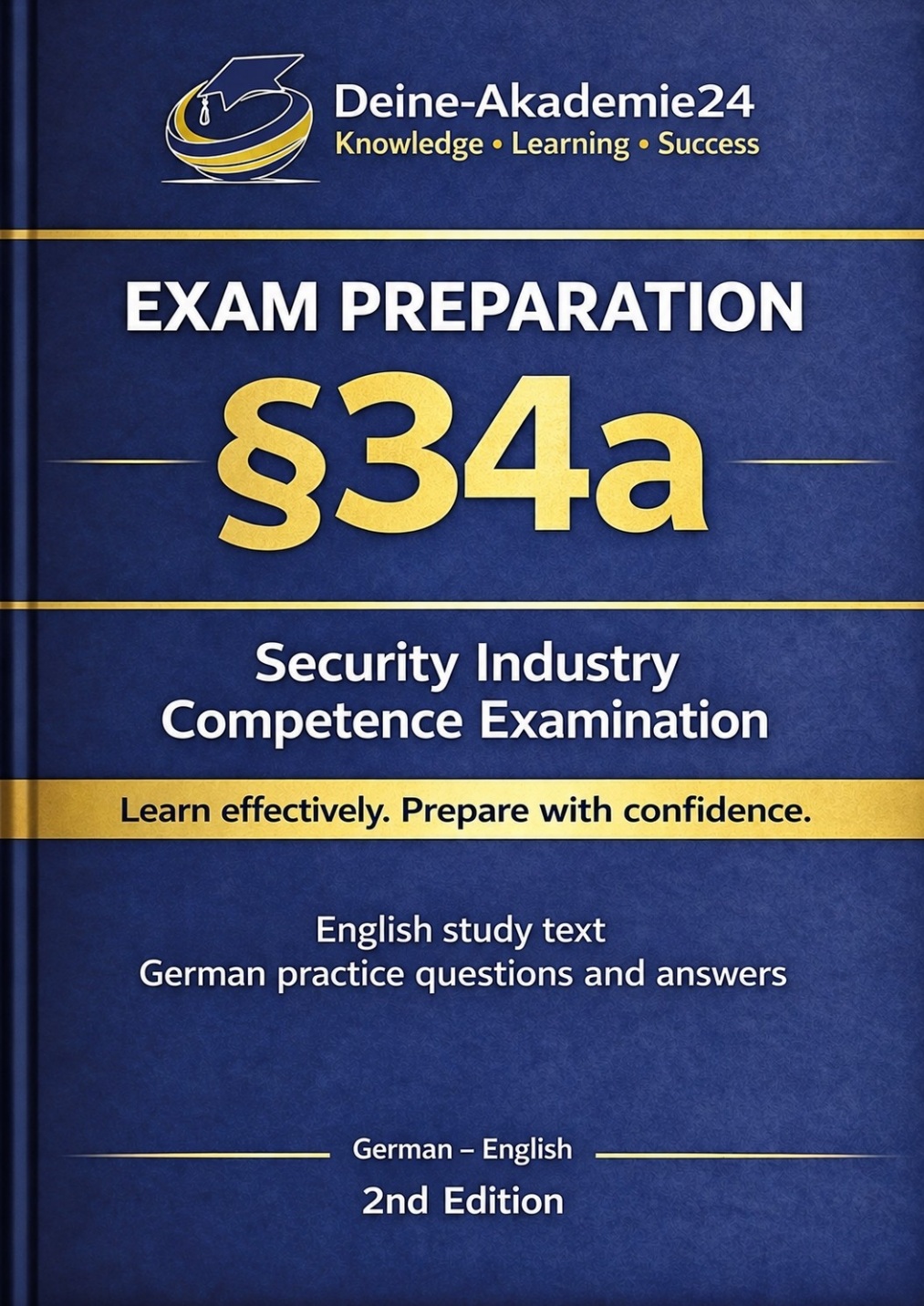
§34a Security Industry – German–English Study Edition, 2nd Edition.
PDF book with 244 pages, front cover, back cover and a detailed contents list.
The teaching explanations are in English. German practice questions and answers are retained to help readers prepare for the German-language IHK examination. English solutions and a German–English glossary support understanding. These are the publisher’s practice questions, not official IHK examination questions.
Review status – please read before purchasing: This book is offered as a review draft. Translation used automated assistance and targeted post-editing. A complete sentence-by-sentence language, technical and legal review and an independent second specialist review have not been completed. Translation errors and inconsistent terminology may remain. Purchase does not change this review status.
Digital PDF download: three downloads within 30 days under the shop’s existing download settings. This product contains the book only; an online course is not included.