

Beschreibung
The Comprehensive Practical Handbook for Successful Business Management and Sustainable Growth
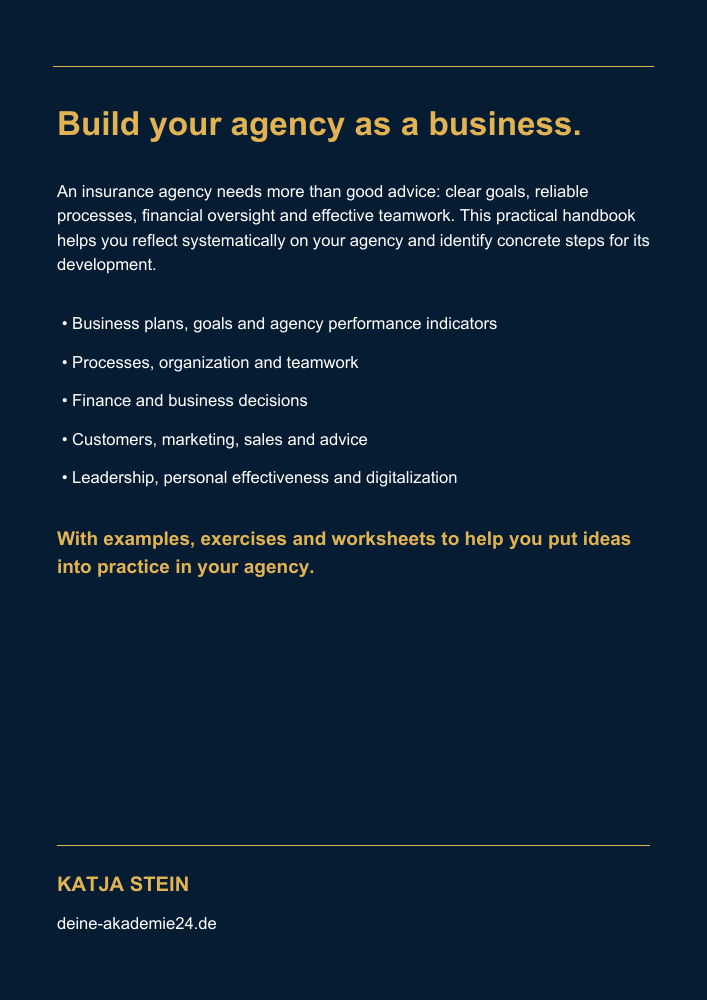
What this book helps you do
Bring structure to your insurance agency through clearer responsibilities, meaningful figures and reliable processes.
- Work through a business plan, objectives and indicators for your agency.
- Map recurring activities and develop workable standards.
- Clarify responsibilities, collaboration and onboarding.
- Connect financial decisions with resources and business priorities.
- Review customer service, marketing and advisory processes.
- Use worksheets and practical assignments to define the next steps for your own operation.
Who is this book for?
For insurance-agency owners, managers and team members developing their organisation and collaboration. The book retains its German-market context.
Topics you will work through
- Business planning and performance indicators
- Agency processes, structure and collaboration
- Finance and business decisions
- Customers, marketing, sales and advice
- Leadership and personal effectiveness
- Digital and hybrid service and worksheets
Look inside before you buy
24 pages: front matter, the complete table of contents and selected teaching or practice pages from this edition. No purchase or registration required. The extract retains the original page numbering.
Check the edition and review-status information below before buying. The sample shows the book as offered; it is not a guarantee of examination success or completed professional review.
View table of contents
Click a chapter heading to expand its subsections.
Foreword and Introduction
- Foreword
- Notes on working with this book
- Examples and Professional Limitations
- Your starting point
- A reliable work rhythm
1. Business Planning and Agency Performance Indicators
- From Top Salesperson to Business Owner
- Specialist, manager and entrepreneur: three tasks in one calendar
- My role change in practice
- Worksheet: My role change in practice
- Worksheet: Personal orientation – Which agency is right for me?
- Values: Decisions Need Clear Standards
- Worksheet: Put My Chosen Values into Practice
- Ikigai as a Reflection Tool for Career Direction
- Worksheet: The four Ikigai areas at a glance
- Explore my career direction with four questions
- Understand Personality Tendencies and Shape Collaboration
- Comfort zone: Translating change into learnable steps
- Define the Agency’s Overarching Business Goal
- Future Vision: How the Agency Will Work in Five Years
- Staff Are Part of the Business Model
- The nine building blocks of the Business Model Canvas in practice
- From Canvas to Business Plan: Connecting Five Sub-Plans
- Agency Performance Indicators: Compare the Plan with Reality
- Evaluate numbers without drawing false conclusions
- Goals and measures for changing roles
- Your work program for the next ninety days
- Result of this chapter
2. Agency Processes
- Consider the Entire Process
- Capture the current situation
- Prioritize tasks
- Describe a standard
- Make task descriptions suitable for everyday use
- Test improvements in a controlled manner
- Involve employees
- Practical Assignment
3. Structure and Collaboration
- Make responsibility visible
- Record activities
- Formulate job descriptions
- Create a Responsibility-Based Organisation Chart
- Derive personnel requirements from tasks
- Recruit and select personnel
- Plan Induction and Training
- Weekly plan
- Location and Handover
- Practical Assignment
- Supplementary templates and samples for Chapter 3: Structure and Collaboration
- Agency Operations Manual
4. Finances and Business Decisions
- Three Calculations for Three Different Questions
- Plan income according to origin and reliability
- Record operating expenses completely and comprehensibly
- Plan staff economically and employ them appropriately
- Employ Relatives and Clarify Their Status Early
- Determine your personal financial needs honestly
- Calculate Owner’s Remuneration and Limit Drawings
- Work Backwards to Required Business Cash Receipts
- Use key figures with clear reference values
- Correctly classify hourly wages and hourly earnings
- View customers and households economically
- Secure liquidity with a monthly plan and reserve
- A multi-account model for clear use of money
- Consider legal form and tax liability together
- Distinguish Cash-Basis Profit Calculation from Accrual Accounting
- Understand the types of taxes in context
- VAT on Insurance Intermediary Services and Other Activities
- Avoid the tax trap of the first few years of business
- Understand depreciation as the distribution of acquisition costs
- Use the Investment Deduction (IAB) Carefully and Purposefully
- Financing investments and personnel decisions
- Use Your Tax Adviser as an Active Planning Partner
- Monthly financial management and practical work assignments
- Sources and calculation notes for Chapter 4
5. Customers and Marketing
- Clarify your own positioning
- Develop Your Personal Brand
- Develop the mission statement from values, vision, mission and mantra
- Understand Customers and Establish Reliable Data
- Classify ABC Customers Using an Illustrative Model
- Use Pareto as a Brief Review Tool
- Develop service packages based on specific needs
- Apply Client Service Standards Reliably
- Consciously design communication with customers
- Use Customer Events as Opportunities for Existing-Customer Service
- Use social media with a clear purpose
- Create a content plan step by step
- Schedule posts at different times using tools
- Use AI sensibly for texts and images
- Use Video to Make Explanations Clear
- Maintain Your Google Business Profile for Local Visibility
- Take Google reviews as honest feedback
- Develop a landing page with AI
- Maintain a marketing plan with budget and evaluation
- Work program for the next ninety days
- Sources and Professional Context for Chapter 5
6. Leadership and personal effectiveness in the insurance agency
- Assess your own leadership needs
- Clarify role responsibility and leadership mandate
- Make attitudes and role models visible in everyday life
- Choose the Right Balance of Guidance, Support and Decision-Making
- Start Self-Leadership with a Review of Your Current Situation
- Combine goals priorities and a realistic weekly rhythm
- Take stress and working conditions seriously
- Check thought patterns and prepare decisions
- Delegate Tasks with Clear Outcomes and Decision-Making Authority
- Follow Up Delegation and Address Reverse Delegation
- Communicate clearly and check understanding
- Conduct conversations with an appropriate framework
- Use the Annual Appraisal for Reflection and Development
- Address personal stresses respectfully
- Structure Recruitment Interviews and Onboarding
- Understanding motivation and creating conducive conditions
- Connect Recognition, Commitment and Reliability
- Recognize talent and plan development
- Enable performance through clear conditions
- Translating goals from the agency strategy into everyday life
- Define and fairly evaluate key figures
- Understand deviations and adjust appropriately
- Looking at teamwork and team dynamics together
- Prepare a team workshop with concrete results
- Identify conflicts early and clarify the issue
- Conduct a conflict discussion step by step
- Give feedback in a concrete and learning-oriented manner
- Accept feedback and promote an open learning culture
- Start Change with a Clear Brief
- Understanding different reactions to change
- Test, Evaluate and Secure Changes
- Building a sustainable leadership rhythm
- A Complete Leadership Case from the Agency
- 30 and 90 days work programme
- Professional Sources and Context for Chapter 6
7. Digital Working and Hybrid Client Service
- Assess the Agency’s Digital Starting Point
- Create a Consistent Customer Journey
- Establish Agreed Systems and Reliable Data
- Conduct Digital Appointments and Video Consultations Reliably
- Exchange Documents Securely and File Them Traceably
- Practically organize data protection and information security
- Distinguish Models, Assistants and Automation
- Choose Suitable AI Tools for Everyday Office Work
- Create Reviewable Drafts with Clear Prompts
- Prepare correspondence and customer information with AI
- Research documents and make knowledge findable
- Check tables and key figures with AI
- Prepare meetings and learning materials
- Build Automation with Approvals and Exceptions
- Use AI agents and programming aids to a limited extent
- Set Clear Limits for Digital Customer Assistants
- Assess Benefits, Costs and Quality Together
- Empower the team and set binding rules
- Implement a Customer Journey with AI Support
- Your work programme for the next thirty and ninety days
- Sources and Context for Chapter 7
8. Sales and Advice
- Reliably handle incoming requests
- Carefully prepare active contacts
- Agree on a clear framework for discussion
- Qualify Prospective Customers
- Identify needs with open and targeted questions
- Explaining the benefits and limits in an understandable way
- Presenting a solution in a structured manner
- Discuss Additional Needs Responsibly
- Treat objections as open questions
- Support Decisions and Prepare to Close the Sale Properly
- Organise Follow-Up and Reminders
- Serving existing customers and winning back customers
- Enable Referrals and Handle Them Properly
- Ask for honest reviews
- Professionally addressing service problems
- CRM and sales management in everyday life
- Developing sales quality in a team
- Introduce the Approach to the Team
- Practical Assignment
- The first implementation plan
- The first 30 days: Identify the starting point and set priorities
- Days 31 to 60: Try a change in a controlled manner
- Days 61 to 90: Decide, Document and Embed
- Establish a regular company meeting
- Template: The monthly company meeting
- Template: The personal 90-day plan
- Conclusion: Turn Planning into Business Management
Worksheets, Closing Remarks and Appendix
- Worksheets
- Worksheet 1: The business plan on two pages
- Worksheet 2: Define Agency Performance Indicators
- Worksheet 3: Describe a process
- Worksheet 4: Roles and Induction
- Worksheet 5: Liquidity and Investment
- Worksheet 6: Positioning and Marketing
- Worksheet 7: Delegation and Employee Conversation
- Worksheet 8: Testing a digital process
- Worksheet 9: Conversation and Weekly Review
- Closing Remarks
- Glossary
- Agency Performance Indicator
- Assumption
- Processing time and throughput time
- Operating profit and liquidity
- Business Model Canvas
- CRM
- Delegation
- End-to-End Case and Completion Criterion
- Hybrid Client Service
- Definition of the indicators
- Customer classification
- Customer relationship and customer loyalty
- Liquidity planning
- Value Proposition
- Process and standard
- Positioning
- Process improvement
- Key Resources
- Follow-Up Reminder
- Future Vision
- Sources and Methodological Context
- Professional Foundations and References
- Basis for the selection of topics
- Figures and graphical representations
- Worksheets
- Final Notes on Methodology
Further edition and purchase information
A practical guide by Katja Stein to developing and organising an insurance agency: business planning, agency processes, structure, finance, customer relationships and marketing, leadership, and digital and hybrid service. Includes examples, diagrams and worksheets. References to German law and the German insurance market are retained.
PDF with cover and back cover. 285 pages. Katja Stein · First edition.