
Beschreibung
Editorial final edition
Revised 19 November 2026. The teaching text, exercises, answer options, solutions, glossary and tables have been reviewed editorially. Factual, calculation and translation corrections are documented in the review record, with checks against primary sources.
This is the publisher’s learning material, not an official examination publication. Independent external legal or specialist approval is not claimed. German law and the applicable examination requirements remain decisive.
What this book helps you do
Organise insurance knowledge around customer needs and practise explaining cover with English teaching texts and German questions.
- Structure a customer needs assessment and prepare advisory conversations.
- Study general contract principles alongside the rules specific to insurance contracts.
- Compare statutory, private and occupational provision.
- Revise life, pension, health, long-term care and accident insurance by topic.
- Distinguish liability, motor, household, building and legal expenses cover.
- Identify knowledge gaps through German practice questions and answers with English solutions.
Who is this book for?
For English-speaking learners preparing for Germany's insurance-intermediary competence examination or revising insurance knowledge.
Topics you will work through
- Customer advice and ongoing support
- Contract, insurance contract and intermediary law
- Consumer protection, competition and supervision
- Statutory, private and occupational pensions
- Health, long-term care and accident insurance
- Property and financial loss insurance
Look inside before you buy
17 pages: front matter, the complete table of contents and selected teaching or practice pages from this edition. No purchase or registration required. The extract retains the original page numbering.
Check the edition and review-status information below before buying. The sample shows the book as offered; it is not a guarantee of examination success or completed professional review.
View table of contents
Taken from the offered edition. The chapter numbering is retained. The original formatted contents pages are also included in the free PDF sample.
- 1 Customer advice
- 1.1 Customer's service expectations
- 1.2 Visit preparation and customer contacts
- 1.3 Customer meetings and ethical principles
- 1.3.1 Customer circumstances and needs
- 1.3.2 Customer-oriented solutions
- 1.3.3 Conversation skills and a structured approach
- 1.4 Customer support
- 2. Legal bases
- 2.1 Contract law
- 2.1.1 Legal capacity to enter transactions
- 2.1.2 Conclusion of general contracts
- 2.1.3 Fundamentals of the insurance contract
- 2.1.4 Start and end of insurance contract
- 2.2 Special rules governing insurance contracts
- 2.2.1 policy document
- 2.2.2 Premium payment
- 2.2.3 Policyholder's policyholder obligation
- 2.2.4 Pre-contractual disclosure duty
- 2.2.5 Increase of risk
- 2.2.6 Duties following a claim event
- 2.2.7 Change of ownership in non-life insurance
- 2.3 Law governing insurance intermediaries and advisers
- 2.3.1 General status
- 2.3.2 Requirements for carrying on the activity
- 2.3.3 Special status
- 2.3.4 Dealing with confli cts of interest
- 2.3.5 Professional associations and bodies
- 2.3.6 Employee representatives
- 2.4 Competition law
- 2.4.1 General principles of competition
- 2.4.2 Unlawful advertising
- 2.5 Consumer protection
- 2.5.1 Fundamentals of consumer protection
- 2.5.2 Dispute-resolution bodies and complaints handling
- 2.5.3 Data protection
- 2.6 Insurance supervision: responsibilities
- 2.7 European internal market: freedom of establishment and services
- 2.8 German Money Laundering Act
- 3. Retirement provision and personal protection
- 3.1 Statutory pension insurance (GRV)
- 3.1.1 Introduction
- 3.1.2 Compulsory insurance
- 3.1.3 Pension-relevant periods
- 3.1.4 Pensions
- 3.1.5 Pension calculation
- 3.1.6 Retirement shortfall
- 3.1.7 Tax treatment of the GRV
- 3.2 Private provision through life and annuity insurance, insurance-based investment products and income- protection insurance
- 3.2.1 Basics
- 3.2.1.4 Premium
- 3.2.1.5 Application procedure
- 3.2.1.6.1 Insured events
- 3.2.1.6.2 Notific ation of the insured event
- 3.2.1.7.1 Participation in surplus and profits
- 3.2.1.7.2 Maintaining the contract
- 3.2.2 State support and tax treatment of private pensions
- 3.2.2.1.1 Product
- 3.2.2.1.2 Tax treatment
- 3.2.2.2.1 Eligible persons
- 3.2.2.2.2 Products
- 3.2.2.2.3 Tax treatment and principles of state support
- 3.2.2.3.1 Tax treatment
- 3.2.2.3.2 Old contracts
- 3.2.2.4 Other insurance products
- 3.3 Occupational pensions through direct insurance and Pensionskasse arrangements using salary conversion
- 3.3.1 Basics
- 3.3.1.1 Definition
- 3.3.1.2 Eligible persons
- 3.3.1.3 Legal entitlement to salary conversion
- 3.3.1.4 Equal treatment
- 3.3.1.5 Vesting
- 3.3.1.6 Leaving employment before retirement
- 3.3.1.7 Early retirement benefit
- 3.3.1.8 Employers' insolvency
- 3.3.2 The direct insurance and Pensionskasse occupational pension routes
- 3.3.2.1.1 Defivnition of direct insurance occupational pensions
- 3.3.2.1.2 Employment-law aspects of direct insurance through salary conversion
- 3.3.2.2.1 Definition of a Pensionskasse
- 3.3.2.2.2 Employment-law aspects of Pensionskasse arrangements through salary conversion
- 3.3.3 Tax treatment of premiums and benefits
- 3.3.3.1.1 Tax treatment of tax-exempt premiums under section 3 no. 63 EStG
- 3.3.3.1.2 Allowance-supported contributions under sections 10a and 79 et seq. EStG
- 3.3.3.1.3 Flat-rate taxation of direct insurance occupational pension contributions under section 40b EStG
- 3.3.3.2 Tax treatment of benefits from direct insurance and Pensionskasse arrangements
- 3.3.4 Social security treatment of contributions and benefits
- 3.3.4.1 Social security treatment of contributions
- 3.3.4.2 Social security treatment of benefits
- 3.4 Statutory and private accident insurance
- 3.4.1 Introduction: needs; target groups
- 3.4.1.1 Needs
- 3.4.1.2 Target groups
- 3.4.2 Statutory Accident Insurance (GUV)
- 3.4.3 Scope of private accident insurance: concept of accident and scope; types of benefits; exclusions; special features
- 3.4.3.1 Concept of accidents and scope
- 3.4.3.2 Types of benefit
- 3.4.3.3 Exclusions
- 3.4.3.4 Special features
- 3.4.4 sum insured; adjustment; special features
- 3.4.4.1 Sums insured
- 3.4.4.2 Adjustment
- 3.4.4.3 Special features
- 3.4.5 Tariff structure and application
- 3.4.6 Application process, insurable persons and application contents
- 3.4.6.1 Insurable persons
- 3.4.6.2 The structure and content of applications
- 3.4.6.3 Underwriting guidelines
- 3.4.7 Insured event
- 3.4.8 Tax treatment of premiums and benefits
- 3.5 Statutory and private health insurance and long-term care insurance
- 3.5.1 Introduction: needs; target groups
- 3.5.1.1 Demand
- 3.5.1.2 Target groups
- 3.5.2.1 Persons insured
- 3.5.2 Statutory health insurance
- 3.5.2.2 Termination possibilities
- 3.5.2.3 Scope of benefits
- 3.5.3 Private health insurance: needs, benefits, premiums, commencement, termination, applications, underwriting and claims
- 3.5.3.1 Customer benefits
- 3.5.3.2 Needs assessment
- 3.5.3.3 Scope of private health insurance
- 3.5.3.4 Premium calculation
- 3.5.3.5 Start and end of insurance coverage
- 3.5.3.6 Basic tariff and emergency tariff
- 3.5.3.7 Application procedure
- 3.5.3.8 Underwriting guidelines
- 3.5.3.9 Insured event
- 3.5.4 Social and private long-term care insurance and supplementary care insurance
- 3.5.4.1.1 Persons insured
- 3.5.4.1.2 Premium calculation
- 3.5.4.1.3 Scope of benefits
- 3.5.4.2.1 Needs
- 3.5.4.2.2 State-subsidised supplementary long-term care insurance
- 3.5.5 Tax treatment of premiums and benefits
- 3.5.5.1 Premiums
- 3.5.5.2 Benefits
- 4. Property insurance and protection against financial loss
- 4.1 Liability insurance
- 4.1.1 Introduction: needs; target groups; liability principles
- 4.1.1.1 Needs
- 4.1.1.2 Target groups
- 4.1.1.3 Liability principles
- 4.1.2 Scope of benefits: liability / coverage; tasks; insured risk; target groups; insured persons; exclusions
- 4.1.2.1 Liability / coverage
- 4.1.2.2 Functions of liability insurance
- 4.1.2.3 Insured risk
- 4.1.2.4 Target groups
- 4.1.2.5 Persons insured
- 4.1.2.6 Exclusions
- 4.1.3 Limit of indemnity
- 4.1.4 Tariff structure and application
- 4.1.5 Application intake: structure and content of applications; underwriting guidelines
- 4.1.5.1 The structure and content of applications
- 4.1.5.2 Underwriting guidelines
- 4.1.6 Insured event
- 4.1.7 Special features
- 4.1.7.1 Specific rules for individual private risks
- 4.1.7.2 Automatic cover for certain new liability risks
- 4.1.7.3 Risk of unpaid damages owed to the insured
- 4.1.7.4 Replacement-value compensation
- 4.1.7.5 Premium adjustment
- 4.1.8 Tax treatment of premiums
- 4.2 Motor insurance
- 4.2.1 Introduction: needs; target groups; liability principles
- 4.2.1.1 Needs
- 4.2.1.2 Target groups
- 4.2.1.3 Liability principles
- 4.2.2 Motor liability insurance: functions, liability and coverage, direct claims, limits, insured persons, exclusions and environmental damage
- 4.2.2.1 Functions of motor liability insurance
- 4.2.2.2 Liability / coverage
- 4.2.2.3 Direct claim
- 4.2.2.4 Limits of indemnity in motor liability insurance
- 4.2.2.5 Persons insured
- 4.2.2.6 Exclusions
- 4.2.2.7 Environmental damage insurance
- 4.2.3 Own-vehicle damage cover: benefits, insured perils, property, compensation and exclusions
- 4.2.3.1 Customer benefits
- 4.2.3.2 Insured risks and damage
- 4.2.3.3 Insured goods
- 4.2.3.4 Compensation
- 4.2.3.5 Exclusions
- 4.2.4 Driver accident insurance benefits
- 4.2.5 Motor assistance cover: insured events, insured persons and exclusions
- 4.2.5.1 Insured risks
- 4.2.5.2 Persons insured
- 4.2.5.3 Exclusions
- 4.2.6 Premium calculation: rating factors, tariff structure and motor-insurance features
- 4.2.6.1 Rating factors
- 4.2.6.2 Tariff structure and application
- 4.2.6.3 Special features of motor insurance
- 4.2.7 Application intake: structure and content of applications; underwriting guidelines
- 4.2.7.1 The structure and content of applications
- 4.2.7.2 Underwriting guidelines
- 4.2.8 Commencement of cover
- 4.2.9 Policyholder obligations
- 4.2.10 Claims: policyholder duties, settl ement and no-claims downgrading
- 4.2.10.1 Obligations of the policyholder
- 4.2.10.2 Claims settl ement
- 4.2.10.3 No-claims downgrading
- 4.2.11 Special features
- 4.2.11.1 Transfer of no-claims discounts
- 4.2.11.2 Change of vehicle
- 4.2.11.3 Laid-up vehicle cover
- 4.2.11.4 Short-term registration plates
- 4.2.11.5 Seasonal registration plates
- 4.2.11.6 Scope
- 4.2.11.7 International Insurance Card
- 4.3. Household contents insurance
- 4.3.1 Introduction
- 4.3.1.1 Needs
- 4.3.2 Household contents cover: insured property, sub-limits, perils, clauses, losses, costs, premises and cover away from home
- 4.3.2.1 Insured goods
- 4.3.2.2 Sub-limits
- 4.3.2.3 Insured risks
- 4.3.2.4 Clauses
- 4.3.2.5 Insured damages
- 4.3.2.6 Insured costs
- 4.3.2.7 Place of insurance
- 4.3.2.8 Temporary cover away from the insured premises
- 4.3.3 Insurance value and sum insured
- 4.3.3.1 Insurance value
- 4.3.3.2 Sum insured
- 4.3.4 Premium calculation: risk factors and tariff structure
- 4.3.4.1 Risk characteristics
- 4.3.4.2 Tariff structure and application
- 4.3.5 Application intake: structure and content of applications; underwriting guidelines
- 4.3.5.1 The structure and content of applications
- 4.3.5.2 Underwriting guidelines
- 4.3.6 Insured event
- 4.3.7 Special features
- 4.3.7.1 Safety regulations
- 4.3.7.2 Increase of risk
- 4.3.8 Glass insurance
- 4.4 Building insurance
- 4.4.1 Introduction: needs, target groups
- 4.4.1.1 Needs
- 4.4.1.2 Target groups
- 4.4.2 Building cover: insured property, perils, losses, clauses, costs and loss of rent
- 4.4.2.1 Insured goods
- 4.4.2.2 Insured risks and damage
- 4.4.2.3 Clauses
- 4.4.2.4 Insured costs
- 4.4.2.5 Insured loss of rent
- 4.4.3 Forms of insurance
- 4.4.4 Compensation for property
- 4.4.5 Premium calculation
- 4.4.6 Application intake: structure and content of applications; underwriting guidelines
- 4.4.6.1 The structure and content of applications
- 4.4.6.2 Underwriting guidelines
- 4.4.7 Insured event
- 4.4.8 Fire cover during construction
- 4.4.9 Special features
- 4.4.9.1 Increase in risk
- 4.4.9.2 Safety requirements
- 4.4.9.3 Change of ownership
- 4.5 Legal expenses insurance
- 4.5.1 Introduction: needs; target groups
- 4.5.1.1 Needs
- 4.5.1.2 Target groups
- 4.5.2 Legal expenses cover: benefits, insured persons, territorial scope and exclusions
- 4.5.2.1 Scope of benefits
- 4.5.2.2 Types of benefit
- 4.5.2.3 Persons insured
- 4.5.2.4 Territorial scope
- 4.5.2.5 Exclusions
- 4.5.3 Premium calculation
- 4.5.4 Application intake: structure and content of applications; underwriting guidelines
- 4.5.4.1 The structure and content of applications
- 4.5.4.2 Underwriting guidelines
- 4.5.5 Insured event
- 4.5.6 Special features
Further edition and purchase information
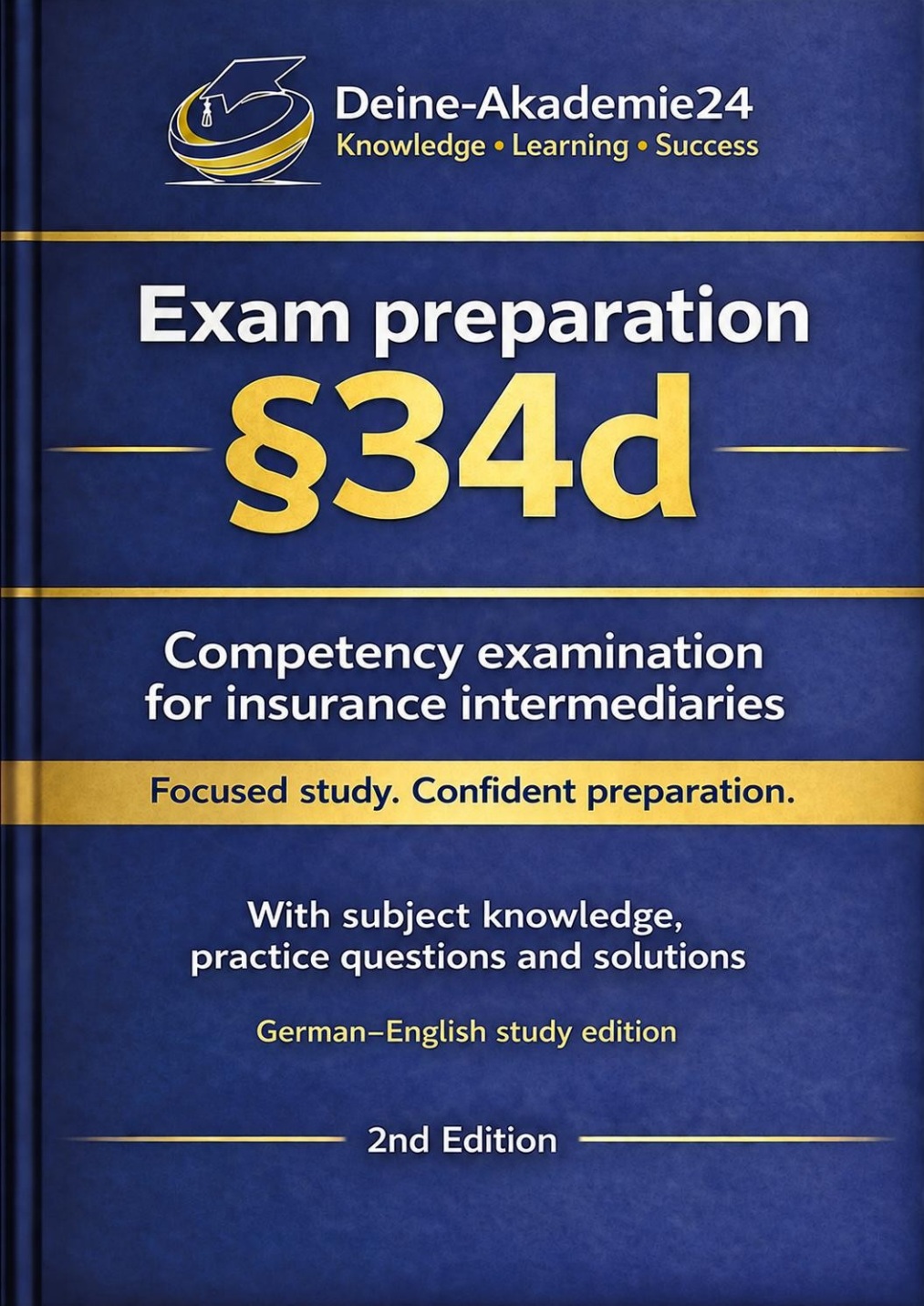
§34d Insurance Intermediation – German–English Study Edition, 2nd Edition.
PDF book with 1230 pages, front cover, back cover and a detailed contents list.
The teaching explanations are in English. German practice questions and answers are retained to help readers prepare for the German-language IHK examination. English solutions and a German–English glossary support understanding. These are the publisher’s practice questions, not official IHK examination questions.
Digital PDF download: three downloads within 30 days under the shop’s existing download settings. This product contains the book only; an online course is not included.