Beschreibung
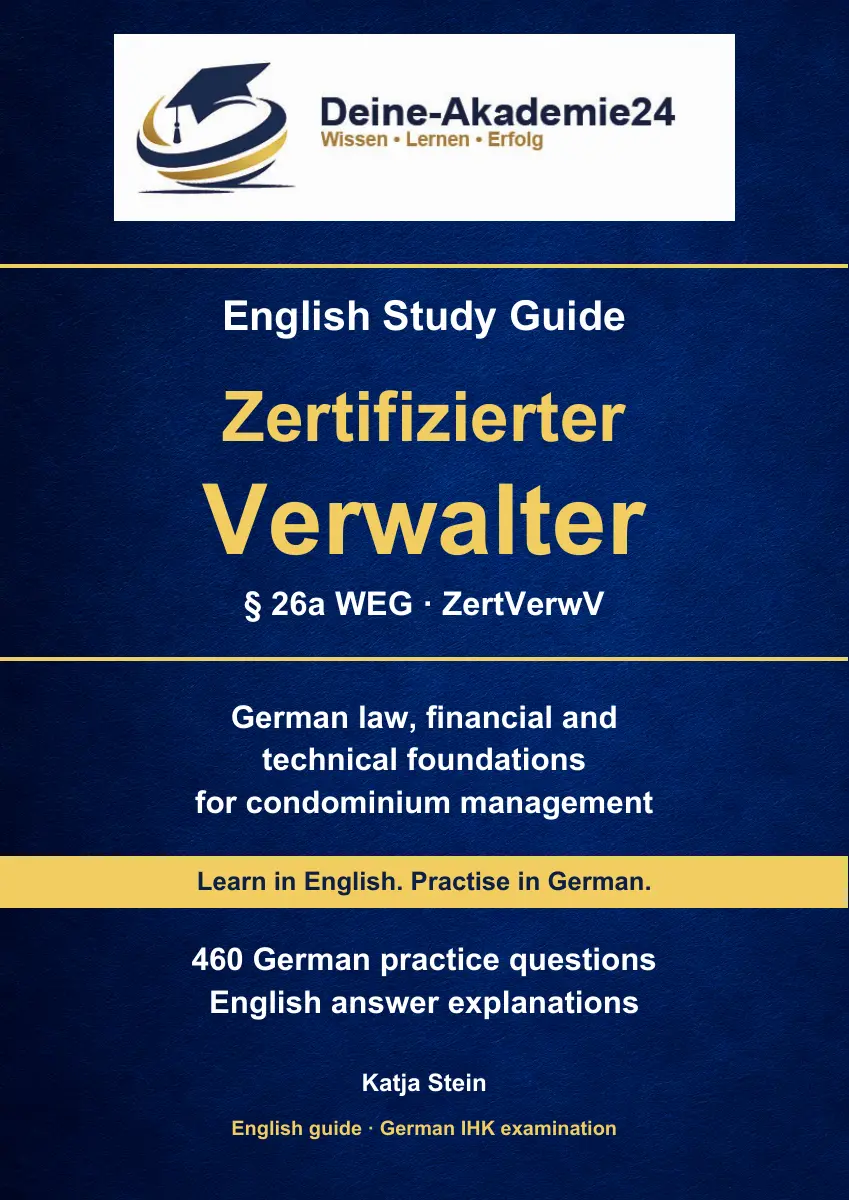
Learn in English. Practise in German.
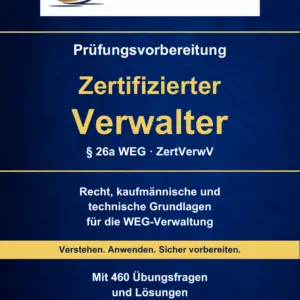
Prepare for the German IHK examination for the zertifizierter Verwalter under § 26a WEG and ZertVerwV. Katja Stein’s study guide explains all four learning areas in English while retaining German professional terminology.
What this edition contains
- English learning text and tables covering real estate, German law, financial management and technical fundamentals.
- 460 German practice questions with five German answer options each.
- The correct answer letter followed by an individual explanation in English.
- A German–English glossary with 161 terms and guidance on reading German examination questions.
- Twelve tables and three photographs, plus practical examples.
Sprachaufbau: Lerntext Englisch, IHK-relevante Begriffe Deutsch; Fragen und Antwortmöglichkeiten Deutsch, Erklärung der richtigen Antwort Englisch. Diese Ausgabe ist für Lernende gedacht, deren Muttersprache nicht Deutsch ist.
Look inside before buying
The free 24-page sample includes the cover, full contents, English learning pages, German questions with English explanations and a financial comparison table.
Kostenlose Leseprobe · Free sample · 24 pages
Inhaltsverzeichnis ansehen · View table of contents
Click a learning area or chapter to view its sections. Headings are taken from the English study guide.
Publication Details
Preface
How to Use This Book
The Examination and Professional Context
Contents
1. Real Estate Fundamentals
1.1 Building Plans, Construction Drawings and Specifications
1.2 Relevant Types of Property Insurance
1.3 Environmental and Energy Issues in Real Estate
2. Legal Foundations
2.1 Wohnungseigentumsgesetz (WEG, Condominium Ownership Act)
2.1.1 Establishing Separate Ownership of Residential and Non-Residential Units
2.1.2 Teilungserklärung (declaration of division), Aufteilungsplan (partition plan) and Gemeinschaftsordnung (community rules)
2.1.3 Legal Capacity of the Gemeinschaft der Wohnungseigentümer (unit owners’ association)
2.1.4 Legal Relationships between Wohnungseigentümer (unit owner) and with the Association
2.1.5 Rights and Duties of Wohnungseigentümer (unit owner)
2.1.6 Unit Owners’ Meeting
Presence, hybrid participation, virtual meeting and circular resolution
2.1.7 Bestellung (appointment to the manager’s organisational role), Abberufung (removal from the manager’s organisational role) and Contract of the Property Manager
Meaning of WEG manager
The Bestellung of the WEG property manager
The Abberufung of the WEG property manager
The difference between Abberufung and termination of the management contract
The Verwaltervertrag
Who concludes the Verwaltervertrag?
The certified property manager
2.1.8 Rights and Duties of the Property Manager
The legal status of the WEG property manager
The tasks and powers according to Section 27 WEG
Representing the unit owners’ association
The management of community funds
The preservation of common property
The implementation of resolutions
The organization of the homeowners' meeting
The information and documentation obligations
Obligations from the Verwaltervertrag (property management contract)
Public law obligations
Duty of Care and Liability
2.1.9 Rights of the Administrative Advisory Board
Meaning and position of the administrative advisory board
Bestellung (appointment to the manager’s organisational role) and composition of the administrative advisory board
Property Manager support
Monitoring the property manager
Review of Wirtschaftsplan (annual budget) and Jahresabrechnung
Access to administrative documents and information
The Chairman of the Administrative Advisory Board
Liability and duties of care
2.2 Bürgerliches Gesetzbuch (BGB, German Civil Code)
Importance of the Civil Code for WEG administration
Structure of the BGB
Legal capacity and capacity
Declarations of intent and contracts
Representation and Vertretungsmacht (power of representation)
Obligations and breaches of duty
Eigentum and Besitz (possession)
Why the BGB is important for WEG management
2.2.1 General Contract Law
What is a contract?
How is a contract concluded?
What forms are there for contracts?
What does Vertragsfreiheit mean?
Who can enter into a contract?
What obligations arise from a contract?
What happens if a contract is not fulfilled?
When is a contract invalid?
How can a contract be terminated?
2.2.2 Tenancy Law
What is tenancy law?
How is a rental agreement concluded?
What obligations does the landlord have?
What obligations does the tenant have?
What is the difference between basic rent, Betriebskosten and warm rent?
Advance payment for operating costs or flat rate for operating costs?
What is a rent deficiency?
Rent reduction
How can a rental agreement be terminated?
Ordinary termination by the tenant
Ordinary termination by the landlord
Extraordinary termination without notice
What is a deposit?
What special features apply to rented condominiums?
2.2.3 Law of Contracts for Work and Services
What is a Werkvertrag (contract for work and services)?
Who are the contracting parties?
How does a contract for work come about?
What obligations does the entrepreneur have?
What obligations does the purchaser have?
What does Abnahme mean?
Why is Abnahme so important?
Do not confuse acceptance fiction and statute of limitations
What is a work defect?
What rights does the purchaser have in the event of defects?
Subsequent fulfillment
Self-completion and reimbursement of expenses
Mitigation
Resignation
Damages
What is the difference between a quote and a binding Angebot?
What happens if the contractor doesn't finish on time?
How does a contract for work end?
2.2.4 Land Law
2.3 Land Registration Law
What is land registry law?
Who keeps the Grundbuch?
What are the tasks of the land registry?
How is the Grundbuch structured?
Inscription
Inventory
Division I – Ownership
Division II – Burdens and Limitations
Division III – Liens
Which principles apply in land register law?
Registration principle
Application principle
Approval principle
Pre-registration principle
Principle of certainty
Principle of publicity and public belief
What is an entry, an amendment and a deletion?
What is the significance of public certification and notarial certification?
What is a reservation in the Grundbuch?
What does rank mean in the Grundbuch?
What is a land register extract and who can view it?
2.4 Civil Procedure and Enforcement Law
What does civil procedure and enforcement law mean?
Civil procedure law: How does a legal dispute work?
Which court has jurisdiction?
Lawsuit, defense and judgment
Evidence and burden of proof
Particular importance for unit owners’ associations
Resolution actions
Housekeeping claims
Statute of limitations
Enforcement law: How are claims enforced?
The enforcement title
Clause and delivery
The judicial dunning procedure
Account seizure
Seizure of property and bailiffs
Foreclosure and receivership of real estate
Who is involved in the foreclosure?
Legal remedies in foreclosure
What does the WEG property manager need to consider in practice?
2.5 Professional Regulation of Property Managers
Basics of commercial law
§ 34c Trade Code (GewO)
What are the requirements for the permit?
What does reliability mean?
What are orderly financial relationships?
Continuing education requirement for residential property managers
The certified property manager according to the WEG
What does “certified manager” mean?
Does every property management company have to have a certified manager?
When is the exception for small communities?
Which people are considered certified?
Professional liability insurance
Obligations from the Verwaltervertrag (property management contract)
Due Diligence
Information and accountability requirements
Dealing with other people's money
Conflicts of interest
Liability of the property manager
Liability towards the community and third parties
Confidentiality and data protection
2.5.1 Gewerbeordnung (GewO, Trade Regulation Act)
2.5.2 Makler- und Bauträgerverordnung (MaBV, Real Estate Broker and Property Developer Ordinance)
Meaning and purpose of MaBV
What rules apply to residential property managers?
Information obligations and advertising
Professional liability insurance
Obligatory further training according to MaBV
Dealing with third-party assets
Checks and possible violations
Delimitation: GewO, MaBV and WEG
2.5.3 Rechtsdienstleistungsgesetz (RDG, Legal Services Act)
Meaning and purpose of the Legal Services Act
What is a Rechtsdienstleistung (legal service)?
Principle: Legal advice is not permitted without restrictions
The most important exception: legal services as an ancillary service
What is a WEG property manager typically allowed to do?
What are the limits?
The role of the lawyer
Other important provisions of RDG
2.6 Other Legal Foundations
Why does a WEG property manager need these legal bases?
The three areas of law at a glance
2.6.1 Heizkostenverordnung (HeizkostenV, Heating Costs Ordinance)
2.6.2 Trinkwasserverordnung (TrinkwV, Drinking Water Ordinance)
2.6.3 Energy Law
The role of the WEG property manager
2.6.1 Heizkostenverordnung (HeizkostenV, Heating Costs Ordinance)
Purpose of the Heating Cost Ordinance
For which buildings and costs does the heating cost regulation apply?
Consumption-based billing: the most important principle
How are the costs divided?
Example: 70/30 distribution
7.000 €
3.000 €
Why are there basic costs at all?
Example with two apartments
Which costs are included in the heating bill?
Consumption recording and reading
Remote-reading measuring devices
What happens when a user changes?
Exceptions to the heating costs regulations
Right to retrenchment in the event of violations
The duties of the WEG property manager
2.6.2 Trinkwasserverordnung (TrinkwV, Drinking Water Ordinance)
Meaning and purpose of the Trinkwasserverordnung
Trinkwasser is not automatically hygienic
Legionella: a particularly important audit topic
When does Legionella have to be tested?
How often do I need to be examined?
Who is responsible for drinking water quality?
What happens when the technical measure value for Legionella is reached?
What should you pay attention to with lead pipes?
Further current operator obligations
What are the practical tasks of the WEG property manager?
2.6.3 Energy Law
The Gebäudemodernisierungsgesetz (GModG, Building Modernisation Act)
Requirements for heating systems
Classify gas and oil heating systems according to the applicable law
Energy certificate
Energy-efficient renovation of the common property
Energy costs and heating costs
Distribution of CO₂ costs
Observe the already regulated later cost distribution
Funding opportunities and cost-effectiveness
3. Financial and Business Fundamentals
Overview of the topics
3.1 General Financial and Business Fundamentals
3.2 Financial Responsibilities in Condominium Management
Why are commercial knowledge important for the manager?
3.1 General Financial and Business Fundamentals
What does accounting mean?
Why is evidence so important?
The most important principles of proper accounting
The separation of corporate accounting and WEG administration
Income, expenses, expenses and income
External accounting
Internal accounting
The difference using an example
The WEG statement is not the company's financial statements
3.1.1 Principles of Proper Buchführung (bookkeeping)
What does proper accounting mean?
The most important principles of proper accounting
Completeness
Accuracy
Timely capture
Order and clarity
Traceability and verifiability
Document principle
Clarity and truth
Protection against loss and unnoticed changes
Handle receipts correctly
Correct accounting errors
Who is responsible for compliance?
3.1.2 Financial and Management Accounting
What is external accounting?
Financial accounting
The Bilanz
The profit and loss statement
What is management accounting?
Cost and activity accounting
Planning and budgeting
Profitability control
The most important differences in comparison
Special feature in WEG management
3.2 Financial Responsibilities in Condominium Management
The specifics of commercial WEG management
Separation of community assets and company assets
The three central areas of responsibility
Special levies and Erhaltungsrücklage (maintenance reserve)
Preparation of the Jahresabrechnung and the annual budget
Hausgeld and dunning
The role of the manager in financial decisions
3.2.1 Special Levies and the Erhaltungsrücklage (maintenance reserve)
The Sonderumlage
What is a Sonderumlage?
When is a Sonderumlage required?
How is a Sonderumlage decided?
How is the amount of a Sonderumlage calculated?
The cost allocation key for a Sonderumlage
When is a Sonderumlage due?
What happens if an owner cannot pay the Sonderumlage?
The Erhaltungsrücklage
What is a Erhaltungsrücklage?
Why is a Erhaltungsrücklage important?
How high does the Erhaltungsrücklage have to be?
Who decides on the amount of the Erhaltungsrücklage?
The earmarking of the Erhaltungsrücklage
How is the Erhaltungsrücklage managed?
Reserve account and joint account
Loan taken out by the unit owners’ association
When can a loan make sense?
Advantages of taking out a loan
Disadvantages and risks of a loan
Risks and obligation to make additional contributions
What solutions are there in cases of financial hardship?
Sonderumlage and Erhaltungsrücklage in comparison
3.2.2 Preparing the Jahresabrechnung (annual statement of accounts) and Budget
The Wirtschaftsplan
Purpose and meaning of the economic plan
Components of the annual budget
Overall economic plan and individual economic plan
Calculation of the condominium contributions
Special features when creating
The Jahresabrechnung
Purpose and meaning
What information does the Jahresabrechnung contain?
Payment invoice and cost distribution are not always identical
Gesamtabrechnung (overall statement of accounts) and Einzelabrechnung (individual statement of accounts)
Abrechnungsspitze and billing result
What happens to outstanding house payment payments?
Due date for additional payments and adjustment amounts
The Vermögensbericht
Contents of the asset report
The reconciliation of accounts and Buchführung
Account reconciliation
Reserve accounts and reserve development
Liquidity development of the unit owners’ association
Example of a liquidity problem
Resolution on Wirtschaftsplan and Jahresabrechnung
Frequent errors in annual budgets and Jahresabrechnung
3.2.3 Hausgeld (condominium contributions) and Arrears Management
The Hausgeld
What is Hausgeld?
How is the amount of the condominium contributions determined?
What is the significance of the Wirtschaftsplan?
When do the Hausgeld have to be paid?
Monitoring house payment payments
Control of incoming payments
The owner account
Why are house payment arrears problematic?
The dunning system
Task and goal of the dunning process
Payment reminder and reminder
When does an owner default?
Late payment interest and other costs
What happens if the owner doesn't pay despite a reminder?
The judicial dunning procedure
Documentation of the dunning process
4. Technical Fundamentals
4.1 Building Materials and Materials Technology
Importance of building materials for real estate management
Basic properties of building materials
The most important building material groups
Mineral building materials
Wood and wood-based materials
Metals
Plastics, glass and sealing materials
Insulating materials
Building materials technology: How are building materials processed and used?
Typical damage patterns and their significance for the property manager
4.2 Building Services
Heating systems
Wärmeerzeuger
Heat distribution and heat transfer
Regulation and typical faults
Trinkwasser and wastewater systems
Drinking water supply
Wastewater plants
Ventilation systems
Electrical systems
Elevators
Testing and emergency organization for elevators
Maintenance, inspection and Instandsetzung (repair)
The role of the WEG property manager during technical failures
4.3 Recognising Defects
What is a structural or technical Mangel?
Why do defects need to be identified early?
Typical defects and their identifying features
Moisture damage and mold formation
Cracks in walls, ceilings and facades
Damage to roof and roof drainage
Damage to facade and masonry
Defects on windows and doors
Damage to floor coverings, stairs and traffic areas
Defects in technical systems
Sichtkontrolle, technical examination and expert opinion
Assess the urgency of a defect
Acute dangers and emergencies
Urgent defects
Foreseeable defects
Record the defect report correctly
Determine the cause and prevent consequential damage
Documentation and tracking
Jurisdiction: Gemeinschaftseigentum or Sondereigentum?
Collaboration with experts
Common errors in defect detection
4.4 Duties to Keep Premises Reasonably Safe
What does Verkehrssicherungspflicht mean?
Who is responsible in a unit owners’ association?
Typical areas of traffic safety
Paths, driveways and outdoor facilities
Staircases, hallways and lighting
Winter service: snow and ice
Leaves, dirt and slippery surfaces
Roof, facade and building parts
Trees, playgrounds and technical facilities
How does the property manager organize traffic safety?
Delegation to caretakers and service providers
Liability for violation of duties to keep premises reasonably safe
4.5 Maintenance Planning
What is meant by conservation planning?
Conservation, Instandhaltung (maintenance), Instandsetzung and modernization
Inventory: What is the current status?
Components and their expected service life
Set priorities: What needs to be done first?
The conservation plan as a multi-year working instrument
Cost planning and Erhaltungsrücklage
Prepare measures and organize decisions
Maintenance planning and energy-efficient renovation
Typical errors in maintenance planning
4.6 Energy-Efficient Refurbishment and Modernisation
What does energy-efficient building renovation mean?
Difference between preservation, modernization and energy-efficient renovation
The energetic Gebäudehülle
Wärmedämmung of the roof and top floor ceiling
Insulation of the external walls
Windows and exterior doors
Thermal bridges
Heating modernization and renewable energies
Heat pumps
Optimization of existing heating systems
Solar thermal energy and photovoltaics
Legal requirements for energy measures
Promotion of energy-efficient renovations
Assess economic viability and financing
Special features in the unit owners’ association
Process of an energy-efficient refurbishment
Typical errors in energy modernizations
4.7 Age-Friendly and Accessible Adaptations
What does age-appropriate, low-barrier and barrier-free mean?
Typical age-appropriate and barrier-free conversions
Ramps and step-free access
Elevators and stair lifts
Doors, hallways and movement areas
Bathrooms and sanitary rooms
Lighting, orientation and controls
Technical requirements and planning
Legal principles in Wohnungseigentum (condominium ownership)
§ 20 WEG: Structural changes
§ 21 WEG: Who bears the costs?
What are the responsibilities of the property manager?
Promoting age-appropriate renovations
Typical errors in age-appropriate and barrier-free conversions
4.8 Using and Applying for Grants and Subsidies
Importance of funding for WEG administration
Types of funding
Grants
Low-interest loans
Loan with repayment subsidy
Tax benefits
Typical funding areas in the WEG administration
Responsibilities: KfW, BAFA and other funding bodies
Check the requirements for funding
The decision-making process in the unit owners’ association
The process of applying for funding
What documents are required?
Combination of several funding programs
Example from practice
Roles and limitations of the WEG property manager
Typical errors in funding applications
4.9 Documentation
Importance of documentation in WEG administration
Legal and organizational principles
Which documents must be documented?
Administrative documents and resolutions
Technical building documents
Orders, invoices and proof of performance
Damage and defect documentation
Maintenance, testing and traffic safety records
Documentation of Instandhaltung (maintenance) and modernization
Digital documentation and file management
Data protection and confidentiality
Retention and deletion of documents
Handover upon change of property manager
Documentation as a basis for conservation planning
Sources and Currency
Preparing for Oral Examination Tasks
Water damage
Fund a conservation measure
Prepare an owners meeting
Completing Your Studies
Reading German Examination Questions
German–English Terminology Guide
Edition and format
Katja Stein · 1st edition 2026 · English Study Guide with German Practice Questions · 387 pages including front and back cover · PDF download, not a printed book. Up to three downloads within 30 days.
Editorial status
Based on the reviewed German edition with a legal and source reference date of 4 November 2026. Translation and editing were AI-assisted; a complete independent specialist language review has not been performed. German statutory provisions remain authoritative. These are practice questions, not official IHK examination questions. No examination pass is guaranteed.